The great cometary show
Jan 19, 2007
The great cometary show
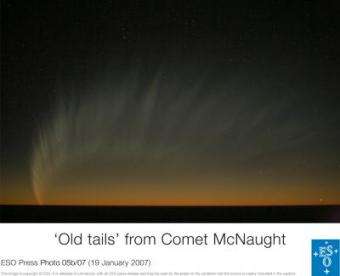
The extended tail of Comet McNaught, seen from Paranal, observed in the evening of Jan. 18, 2007, when the comet was setting behind the Pacific Ocean. The planet Venus is visible in the lower right of the image. Credit: ESO

Comet McNaught, the Great Comet of 2007, is no more visible for observers in the Northern Hemisphere. It does put an impressive show in the South, however, and observers in Chile, in particular at the Paranal Observatory, were able to capture amazing images, including a display reminiscent of an aurora!

Comet C/2006 P1 was discovered in August 2006 by Robert McNaught on images taken by D. M. Burton with the 0.5-m Uppsala Schmidt telescope in the course of the Siding Spring Survey (Australia). It is one of 29 comets discovered by this telescope since early 2004 in a project to systematically search the southern skies for asteroids, or comets, that can pass close to the Earth. At that time, the comet was only a very faint, barely diffuse object, about 50 000 times fainter than what the unaided eye can see.

However, as the comet came closer to the Sun, it brightened rapidly, in such a way as to become easily visible with the unaided eye in early January 2007, becoming brighter than Comet Hale-Bopp and Comet West, thereby earning its title of Great Comet of 2007. It even became the brightest comet in more than 40 years.

Comet McNaught had its closest approach to the Sun on 12 January, being well inside the orbit of Mercury, with a minimum distance of only 17% the mean Earth-Sun distance. On January 13, it reached its maximum brightness when it was possibly brighter than Venus.

In early January, it was visible in the northern hemisphere but after passing the Sun, it only became visible from the southern hemisphere, entering the constellation Microscopium (The Microscope) on 18 January.

Astronomers in ESO's observatories in Chile are thus optimally placed to enjoy the show and certainly do not want to miss it. The comet displays a vivid coma and a lovely, sweeping tail.

As the night deepens, and the comet had set, it revealed a sweeping fan that gives onlookers the impression they are witnessing an aurora, albeit the phenomenon is completely different. The structure in the tail is probably the fingerprint of past bursts of activity of the comet, releasing small dust particles whose paths are deflected by the solar light.

The comet is now heading further south and should still be nicely visible for southern observers for several days.

Source: European Southern Observatory

Explore further: NASA builds unusual testbed for analyzing X-ray navigation technologies

add to favorites email to friend print save as pdf

Related Stories

Herschel links Jupiter's water to comet impact

Apr 23, 2013

(Phys.org) —ESA's Herschel space observatory has solved a long-standing mystery as to the origin of water in the upper atmosphere of Jupiter, finding conclusive evidence that it was delivered by the dramatic ...

How a sunset comet came to be

Mar 18, 2013

(Phys.org) —For a comet, visiting the sun is risky business. Fierce solar heat vaporizes gases long frozen in the fragile nucleus, breaking up some comets and completely destroying others.

Comet posing beside crescent moon in cool photo op

Mar 11, 2013

Now's your chance to see the comet that passed within 100 million miles of Earth last week. Twilight on Tuesday will provide the best photo op for the comet called Pan-STARRS. It will be visible in the Northern ...

A naked-eye comet invites itself to the March sky, 2013

Mar 08, 2013

It will appear in the West at sunset, from around the 8th to the 13th of March 2013, and will be visible to the naked eye up to the end of the month. Comet Pan-Starrs C/2011 L4 will traverse Cetus, Pisces, ...

Comet PANSTARRS rises to the occasion mid-March

Mar 08, 2013

(Phys.org) —Comets visible to the naked eye are a rare delicacy in the celestial smorgasbord of objects in the nighttime sky. Scientists estimate that the opportunity to see one of these icy dirtballs advertising ...

Comet Pan-STARRS holds promise for stargazers

Mar 06, 2013

A rare bright comet shows up in the northern hemisphere this week, cruising past Earth with promise of spectacular naked-eye viewings of the giant ball of ice and dust streaking the twilight sky with a blazing ...

Recommended for you

Galaxy's Ring of Fire

May 18, 2013

Johnny Cash may have preferred this galaxy's burning ring of fire to the one he sang about falling into in his popular song. The "starburst ring" seen at center in red and yellow hues is not the product of ...

User comments : 0

More news stories

Slow earthquakes: It's all in the rock mechanics

(Phys.org) —Earthquakes that last minutes rather than seconds are a relatively recent discovery, according to an international team of seismologists. Researchers have been aware of these slow earthquakes, ...

New immune system discovered

(Medical Xpress)—A research team, led by Jeremy Barr, a biology post-doctoral fellow, unveils a new immune system that protects humans and animals from infection.

Lab sets a new record for creating heralded photons

(Phys.org) —Entanglement, by general consensus of physicists, is the weirdest part of quantum science. To say that two particles, A and B, are entangled means that they are actually two parts of an inseparable ...

Protein study suggests drug side effects are inevitable

A new study of both computer-created and natural proteins suggests that the number of unique pockets – sites where small molecule pharmaceutical compounds can bind to proteins – is surprisingly small, meaning drug side ...