Chemists Make Molecular Rings in Shape of King Solomon's Knot
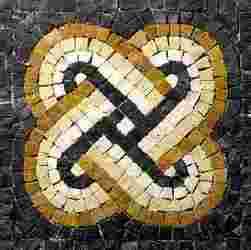
UCLA chemists have made, at the nanoscale, a molecular compound of interlocked rings that has the shape of the ancient King Solomon's knot, a symbol of wisdom that is thousands of years old and is widely used in architecture and works of art. The Bible portrays Solomon as great in wisdom, wealth and power.
"King Solomon, according to Italian legend, was on a hill and was charged by God with protecting a village from large boulders that were going to roll down and destroy the village," said UCLA chemistry graduate student Cari Pentecost, lead author of the Solomon's knot research, which was published in this year's first issue of the German chemistry journal Angewandte Chemie. "King Solomon was holding three large boulders and took a rope and devised this knot to support the boulders and protect the town."
"Our research is a marriage of nanoscience, mathematics and art," Pentecost added.
The Solomon's knot is composed of two rings that interlace each other four times, with alternating crossing points that go over, under, over and under as one traces around each of the rings. Pentecost's nano-version is roughly 2 nanometers high - about 1,000 times smaller than a red blood cell and 10,000 times smaller than the diameter of a human hair - by 1.2 nanometers wide.
Pentecost conducts research in the laboratory of J. Fraser Stoddart, director of the California NanoSystems Institute (CNSI), who holds UCLA's Fred Kavli Chair in Nanosystems Sciences and who last December was awarded a knighthood by Queen Elizabeth II of Britain for his work in chemistry and nanotechnology.
Pentecost produced the molecular Solomon's knot while performing experiments on molecular Borromean rings, which are comprised of three interlocked rings that form an inseparable union such that cutting any one ring results in the other two falling apart. Stoddart's research team developed this mechanically interlocked Borromean compound in 2004, and the research was published in the May 28, 2004, issue of Science.
Pentecost decided to change the recipe for making molecular Borromean rings ever so slightly. With the knowledge that if she used either zinc or copper ions as the template for a particular chemical reaction, she would get only the molecular Borromean rings, Pentecost instead used equal amounts of zinc and copper ions, and the result was crystals of the molecular Solomon's knot 10 out of 10 times.
"Synthetic chemistry is ready to make substantial inroads into some quite exotic molecules in the shape of knots and links," said Stoddart, who believes the molecular Borromean rings and the Solomon's knot are likely to have future applications. "There is oftentimes a connection between the beauty and elegance of a chemical structure and its potential usefulness, and this Solomon knot structure is quite beautiful and elegant."
The Solomon's knot is carved, painted, sculpted, stitched, crocheted, knitted, inlaid and beaded in cultural relics from Europe, the Middle East and elsewhere, according to Lois Rose Rose, author of "Seeing Solomon's Knot" and a UCLA graduate. The design, which is found in numerous buildings, can be seen in the floor tiles and on the wooden ceilings of UCLA's Powell Library and on the outside architecture of UCLA's Haines Hall and Moore Hall.
"Here I am, making molecules of these Solomon's knots, and everywhere I go on the campus, they are staring me in the face or I am walking into them," Pentecost said.
Speaking of the excitement of nanoscience, Stoddart said, "We have to try to rediscover the spirit of the Renaissance, when there were no boundaries. Nanoscience is a replay of previous industrial revolutions. In the 21st century, people will start to appreciate what a nanoparticle or nanowire is, just as in the past they embraced the invention of the wheel or the highway."
Stoddart said that making the molecular counterparts of Borromean rings and Solomon's knots is a form of chemical evolution on the nanoscale.
"In the making of these exotic compounds, chemical bonds are being broken just as fast as they are being formed, until the compound that feels most comfortable emerges as the final product," he said. "A kind of Darwinian selection process is going on in a playful kind of way in the 'room at the top.' Cari Pentecost's contribution was to find, accidentally, the particular set of keys that opens the combination lock to the door to yet another of these rooms at the top."
Co-authors on the research are former UCLA postdoctoral scholars Kelly Chichak and Andrea Peters, both of whom worked in Stoddart's research group; Gareth Cave, an X-ray crystallographer at Nottingham Trent University; and Stuart Cantrill, a former research associate in Stoddart's research group.
Source: UCLA


