Research Continues for Deep Space Travel Propulsion
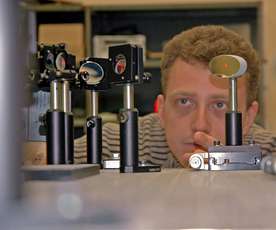
Graduate students and faculty researchers at The University of Alabama in Huntsville are investigating propulsion concepts that could eventually revolutionize deep space travel.
The Plasmoid Thruster Experiment (PTX) is a stepping stone to a highly efficient propulsion concept which could ultimately change how we travel in space, according to Dr. Jason Cassibry, a researcher in UAH’s Propulsion Research Center.
“Larger, more powerful versions can produce fusion for both power and space propulsion, allowing human travel to the outer planets,” he said.
Few groups around the country are working on this emerging technology, according to Cassibry. UAH is among that small number of research institutions.
The experimental branch of the Propulsion Research Center’s pulsed plasma research group is focused on gathering experimental data from PTX, which was originally built at NASA's Marshall Space Flight Center. MSFC donated the equipment to UAH last year.
The purpose of the PTX is to investigate the fundamental plasma and acceleration properties of a small-scale, pulsed plasma thruster.
PTX works by ringing a single turn conical theta pinch coil at about 500 kHz, ionizing and accelerating a small quantity of gas. The magnetic field inside the coil creates a plasmoid, a plasma that has a closed magnetic field structure.
One of the biggest challenges in any electric propulsion concept is increasing the lifetime of the thruster, which must run continuously for several years for deep space missions. Most electric propulsion concepts use plasma, which is in contact with electrodes or acceleration grids, causing erosion of the components and limiting the lifetime of the thruster. The plasmoid thruster potentially has a much longer lifetime, because the plasma is formed inductively, which means that the plasma is not in contact with the thruster components.
UAH researchers ran system tests and calibrations in October, and today the equipment is at full capacity.
In the short term, PTX will continue to take data in support of the ongoing development of the numerical models. This will be accomplished by using a laser interferometer to measure the plasma density. Also, magnetic field measurements help to determine size of the plasmoid. Together, these diagnostics provide a lot of information without affecting the plasmoid itself, according to Cassibry.
In the long term, the PTX experiment will be expanded by varying the coil geometry, adding bias flux and changing the initial conditions to study the effect on the coupling efficiency between the primary coil current and the secondary current in the plasmoid in an effort to improve plasma acceleration and thrust.
“Our experimental pulsed plasma group is keeping a watchful eye on the field of plasma science,” Cassibry said. “We believe that we now have the means and the ability to support further scientific developments in this field.”
Source: University of Alabama Huntsville


