System X Used to Model Behavior of Entire Structures
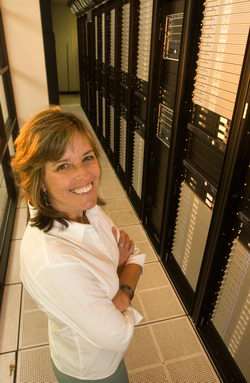
Elisa Sotelino, professor of civil and environmental engineering at Virginia Tech, has developed a family of parallel algorithms, named Group Implicit Algorithms, which have had a major impact in the nonlinear dynamic analysis of structures.
“I don’t do dirty,” Elisa Sotelino says with her contagious laugh as she describes her engineering work.
What she does do is use Virginia Tech’s squeaky clean supercomputer, System X, to learn how entire structures will behave under different circumstances such as a compartment fire or an earthquake.
“I am using the knowledge of the computer scientist and applying it to structural engineering,” the Brazilian native explains, thus bridging the two disciplines.
A simple explanation might be the following. In the laboratory, a structural engineer will evaluate the load a bridge girder will sustain before failing. On the highway, a driver sees the result of this testing by the display of a road sign that says “Weight limit: 20 tons” just before the bridge crossing.
“What I do is take the initial information that the structural engineer obtains in the lab and create mathematical models to predict loads for similar structures,” Sotelino says. “My models are very large and I need the advantages of the parallel computing capabilities of System X to run these models. However, in order to fully take advantage of this computer’s architecture new algorithms must be devised.”
Oftentimes, when a structure is built, there is an imprecise “margin of error so the designer will enact a margin of safety. I call this a margin of ignorance,” Sotelino says.
With an infinite amount of money or by placing a building underground, “we can prevent the catastrophic structural failure that occurred with the World Trade Center,” but these answers are not feasible in the real world, Sotelino says.
“We can solve any mathematical problem, but the bottom line issues are always money and visual appeal,” the internationally recognized expert asserts.
One of her major contributions in her field is a family of parallel algorithms, named Group Implicit algorithms, which have had a major impact in the nonlinear dynamic analysis of structures.
Sotelino also created an object-oriented, concurrent software development environment for computationally intensive structural engineering applications. Called Structural Engineering Concurrent Software Development Environment (SECSDE), its components facilitate the reuse, rapid prototyping and portability of parallel finite element analysis software for programming and execution of computationally intensive structural engineering applications.
Part of Virginia Tech’s first cluster hire in the area of computational science and engineering, Sotelino was attracted to the Blacksburg campus because of System X . For 14 years, she had excelled on the Purdue University faculty as a member of its school of civil engineering (CE).
“I have always been open to new possibilities,” Sotelino says, “and when Virginia Tech recruited me, it felt right.”
Since arriving at Virginia Tech, Sotelino has initiated research ventures with a number of faculty, including Linbing Wang and others in the transportation area, Layne Watson and others in the Computer Science department, as well as her colleagues in structural engineering, and she continues to work with researchers at Purdue.
Source: Virginia Tech


