Saturn dominates the night sky in January
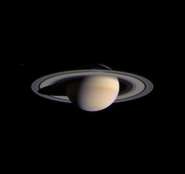
The highlight of January will be the planet Saturn, which will rise in the east around 8 p.m. local time at the start of the month and two hours earlier by month's end. The planet with the famous rings will be almost at its biggest and brightest as it crosses the southern sky, remaining visible most of the night.
When Saturn is high in the south on a clear night, there is no better opportunity to view its rings with a telescope. Saturn will remain at almost the same brilliance all month as it dominates the stars of the constellation Leo the Lion. Over the next few weeks Saturn will gradually move away from Leo's brightest star, Regulus.
Saturn's moon Titan, which is larger than the planet Mercury, can be seen with any telescope in a clear dark sky. It will be directly north of Saturn on Jan. 3 and Jan. 19 and directly south of the planet on Jan. 11 and Jan. 27. Wait until the constellation Leo has completely cleared the horizon before you turn a telescope on Saturn, to avoid the turbulence in Earth's atmosphere that will otherwise blur your view of the planet.
While you wait for Saturn to gain altitude in the east, you can enjoy the sight of the planet Venus blazing low in the west-southwest. This "evening star" will appear about a half hour after sunset, shining through the afterglow of twilight.
During the last week of the month, Venus will be joined by much fainter Mercury as the smallest planet climbs out of the twilight into a dark sky. Mercury by itself can be hard to find, and this will be a fine opportunity to see it using Venus as a conspicuous marker. Mercury will be below Venus and slightly to the right (west).
Jupiter will rise in the southeast around 4 a.m. local time in January, easily outshining every other object in the morning sky. The brilliant white planet will pass north of the bright orange star Antares of the constellation Scorpius as the month goes by.
Far below Jupiter will be Mars, which will be close to the southeastern horizon and difficult to see this month.
Meteor shower
The Quadrantid meteor shower will be active for the first week of January, peaking on the night of Jan. 3-4 during the hours before dawn. The moon will be full during the peak, obscuring the fainter meteors, so viewing conditions will not be favorable. Try to find a spot where the moon is blocked by a building or trees. The rate of this shower varies considerably and unpredictably from year to year.
The Quadrantid meteors will appear to come from a point called the radiant near the end of the handle of the Big Dipper, which will rise in the northeast. The radiant is in the constellation Bootes the Herdsman, which contains the bright orange star Arcturus as a conspicuous marker. In the 18th century, this area of the sky was called Quadrans Muralis and gave the Quadrantid meteor shower its name.
Try facing northeast toward the Big Dipper. If you extend the curve formed by the handle's three stars, it forms an "arc to Arcturus." Meteors should be visible in all parts of the sky, but the higher Arcturus is above the eastern horizon, the more meteors there will be. More information about viewing meteor showers, including the Quadrantids, is available from the American Meteor Society at www.amsmeteors.org/showers.html .
Moon phases
The moon will be full on Jan. 3, at third quarter on Jan. 11, new on Jan. 18 and at first quarter on Jan. 25.
Source: Indiana University


