Samsung Develops 1/4 inch 3-megapixel CMOS Image Sensor for Ultra Slim Camera Phones
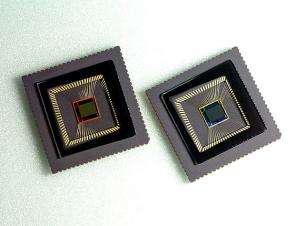
Samsung Electronics Co., Ltd., the leader in advanced semiconductor technology, announced the world's first 3-megapixel (M-pixel) CMOS image sensor (CIS) with a 1/4-inch lens aperture that is well suited for ultra slim camera phones.
"The rapidly evolving trend of user created content, blogs, and personal web pages is triggering demand for constant access to high-resolution images, bringing the consumer's attention to high-resolution camera phones," said Yong-Hee Lee, vice president of Samsung Electronics' System LSI Division.
"Our 1.75um-pixel, 1/4-inch lens aperture 3M-pixel CIS is a unique combination of Samsung's high resolution sensor technology and high speed serial interface that brings digital still camera-level picture quality to mobile handsets." Samsung's new 1.75um-size pixel enables the 1/4-inch lens aperture to drastically reduce the camera module size by 30 percent as opposed to a conventional 2.25um pixel 1/3-inch lens aperture 3M-pixel CIS. The small form factor allows the 1.75um-pixel, 1/4-inch lens aperture 3M-pixel CIS to immediately replace a 1/4-inch lens aperture 2M-pixel CIS module, as it shares the same physical measurements with the new 3M-pixel CIS.
The 1.75um pixel, 1/4-inch lens aperture 3M-pixel CIS shows no degrading in the picture quality compared to a 2.25um pixel, 1/3-inch lens aperture 3M-pixel CIS. The new CIS chip provides a small form factor and high picture quality.
By utilizing 90-nanometer (nm) process technology, Samsung expects to mass produce the new 1.75um pixel, 1/4-inch lens aperture 3-Mp CIS in the first quarter of 2007. The new CIS chip uses Samsung's proprietary 90nm copper technology that reduces the distance between the micro-lens to the photo diode thereby resulting in maximizing the light-gathering efficiency to overcome the potential decline of image quality as the pixel size scales down.
According to market research firm iSuppli, camera phones are expected to account for 777million units, which is 74 percent of total mobile phones in 2007. 3M-pixel and higher resolution phones are expected to take up 13 percent of total camera phones. And with the increasing demand of high-resolution camera phones, this portion is expected to reach 38 percent in 2008.
Source: Samsung


