Scientists Predict Big Solar Cycle
Dec 22, 2006
Scientists Predict Big Solar Cycle
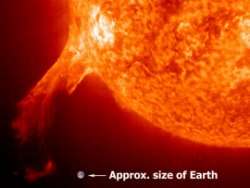
An erupting solar prominence photographed by the Solar and Heliospheric Observatory (SOHO).

Evidence is mounting: the next solar cycle is going to be a big one. Solar cycle 24, due to peak in 2010 or 2011 "looks like its going to be one of the most intense cycles since record-keeping began almost 400 years ago," says solar physicist David Hathaway of the Marshall Space Flight Center. He and colleague Robert Wilson presented this conclusion last week at the American Geophysical Union meeting in San Francisco.

Their forecast is based on historical records of geomagnetic storms.

Hathaway explains: "When a gust of solar wind hits Earth's magnetic field, the impact causes the magnetic field to shake. If it shakes hard enough, we call it a geomagnetic storm." In the extreme, these storms cause power outages and make compass needles swing in the wrong direction. Auroras are a beautiful side-effect.

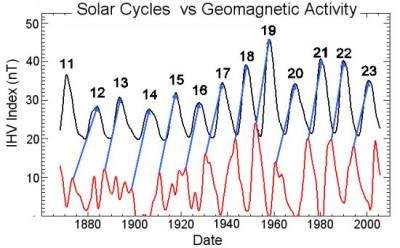
Hathaway and Wilson looked at records of geomagnetic activity stretching back almost 150 years and noticed something useful:. "The amount of geomagnetic activity now tells us what the solar cycle is going to be like 6 to 8 years in the future," says Hathaway. A picture is worth a thousand words:
Scientists Predict Big Solar Cycle
Peaks in geomagnetic activity (red) foretell solar maxima (black) more than six years in advance. Credit: NASA

In the plot, above, black curves are solar cycles; the amplitude is the sunspot number. Red curves are geomagnetic indices, specifically the Inter-hour Variability Index or IHV. "These indices are derived from magnetometer data recorded at two points on opposite sides of Earth: one in England and another in Australia. IHV data have been taken every day since 1868," says Hathaway.

Cross correlating sunspot number vs. IHV, they found that the IHV predicts the amplitude of the solar cycle 6-plus years in advance with a 94% correlation coefficient.

"We don't know why this works," says Hathaway. The underlying physics is a mystery. "But it does work."

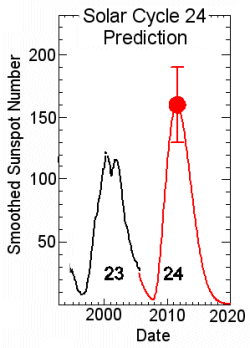
According to their analysis, the next Solar Maximum should peak around 2010 with a sunspot number of 160 plus or minus 25. This would make it one of the strongest solar cycles of the past fifty years—which is to say, one of the strongest in recorded history.
Scientists Predict Big Solar Cycle
Hathaway and Wilson's prediction for the amplitude of Solar Cycle 24. Credit: NASA

Astronomers have been counting sunspots since the days of Galileo, watching solar activity rise and fall every 11 years. Curiously, four of the five biggest cycles on record have come in the past 50 years. "Cycle 24 should fit right into that pattern," says Hathaway.

These results are just the latest signs pointing to a big Cycle 24. Most compelling of all, believes Hathaway, is the work of Mausumi Dikpati and colleagues at the National Center for Atmospheric Research (NCAR) in Boulder, Colorado. "They have combined observations of the sun’s 'Great Conveyor Belt' with a sophisticated computer model of the sun’s inner dynamo to produce a physics-based prediction of the next solar cycle." In short, it's going to be intense.

"It all hangs together," says Hathaway. Stay tuned for solar activity.

Source: by Dr. Tony Phillips, Science@NASA

Explore further: Unusual supernova is doubly unusual for being perfectly normal

add to favorites email to friend print save as pdf

Related Stories

Hinode and SOHO paint an asymmetrical picture of the Sun

Apr 20, 2012

Approximately every 11 years the magnetic field on the sun reverses completely – the north magnetic pole switches to south, and vice versa. It's as if a bar magnet slowly lost its magnetic field and regained ...

Solar storm shakes Earth magnetic field

Mar 09, 2012

(AP) -- A solar storm shook the Earth's magnetic field early Friday, but scientists said they had no reports of any problems with electrical systems.

Sunspots could soon disappear for decades: study

Sep 15, 2010

(PhysOrg.com) -- Sunspot formation is triggered by a magnetic field, which scientists say is steadily declining. They predict that by 2016 there may be no remaining sunspots, and the sun may stay spotless ...

Recommended for you

Three centaurs follow Uranus through the solar system

Jun 18, 2013

Astrophysicists from the Complutense University of Madrid have confirmed that Crantor, a large asteroid with a diameter of 70 km has an orbit similar to that of Uranus and takes the same amount of time to ...

Final curtain for Europe's deep-space telescope

Jun 17, 2013

The deep-space telescope Herschel took its final bow on Monday, climaxing a successful four-year mission to observe the birth of stars and galaxies, the European Space Agency (ESA) said.

Hubble spots a very bright contortionist

Jun 17, 2013

(Phys.org) —The contorted object captured by Hubble in this picture is IRAS 22491-1808, also known as the South America Galaxy. It is an ultra-luminous infrared galaxy (ULIRG) that emits a huge amount of ...

Study explains decades of black hole observations

Jun 14, 2013

(Phys.org) —A new study by astronomers at NASA, Johns Hopkins University and Rochester Institute of Technology confirms long-held suspicions about how stellar-mass black holes produce their highest-energy ...

User comments : 0

More news stories

China astronauts float water blob in kids' lecture

Astronauts struck floating martial arts poses, twirled gyroscopes and manipulated wobbling globes of water during a lecture Thursday from China's orbiting space station that's part of efforts to popularize ...

Metamorphosis of moon's water ice explained

Using data gathered by NASA's Lunar Reconnaissance Orbiter (LRO) mission, scientists believe they have solved a mystery from one of the solar system's coldest regions—a permanently shadowed crater on the ...

Danish chemists in molecular chip breakthrough

Electronic components built from single molecules using chemical synthesis could pave the way for smaller, faster and more green and sustainable electronic devices. Now for the first time, a transistor made ...

Sony chief says time needed to study proposal

Sony Corp. needs more time to study a key proposal from a U.S. hedge fund to spin off a part of its entertainment unit as a way to propel its fledgling revival, the chief executive told shareholders Thursday.