Taking nanolithography beyond semiconductors
Dec 14, 2006
Taking nanolithography beyond semiconductors
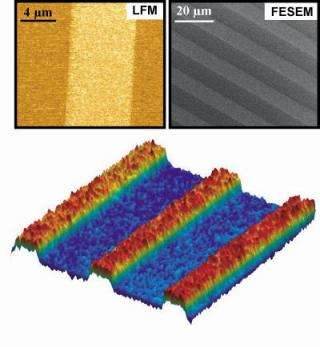
A new technique of chemical patterning developed at Penn State combines conventional lithography with molecular self-assembly for the creation of multifunctional surfaces. In this technique, a robust lithographic resist is patterned to protect chemical functionality in selected areas. In unprotected areas, the chemical functionality is selectively removed so that other chemical functionality can be placed in these regions. The process can be repeated to create multifunctional surfaces. (top left) A lateral-force microscopy (LFM) image contrasting COOH-terminated regions of high friction (light) with CH3-terminated regions (dark). (top right) Field-emission scanning-electron microscope (FESEM) image contrasting the COOH-terminated regions (dark) and CH3-terminated regions (light) (bottom) 3D rendered Field-emission scanning-electron microscope (FESEM) image of a surface patterned with two chemical functionalities. Credit: Penn State

A new process for chemical patterning combines molecular self-assembly with traditional lithography to create multifunctional surfaces in precise patterns at the molecular level. The process allows scientists to create surfaces with varied chemical functionalities and promises to extend lithography to applications beyond traditional semiconductors.

The new technique, which could have a number of practical chemical and biochemical applications, will be described in the 22 December 2006 issue of the journal Advanced Materials by a team led by Paul S. Weiss, distinguished professor of chemistry and physics at Penn State and Mark Horn, associate professor of engineering science and mechanics at Penn State.
Taking nanolithography beyond semiconductors
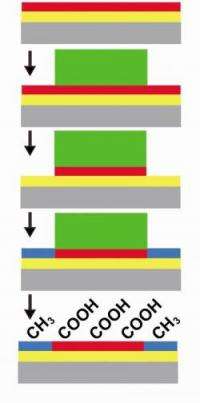
A new technique of chemical patterning developed at Penn State combines conventional lithography with molecular self-assembly for the creation of multifunctional surfaces. In this technique, a robust lithographic resist is patterned to protect chemical functionality in selected areas. In unprotected areas, the chemical functionality is selectively removed so that other chemical functionality can be placed in these regions. The process can be repeated to create multifunctional surfaces. A schematic of the photolithography-assisted chemical patterning technique, using organic-acid molecules (COOH, red) as the first component of the self-assembled monolayer (SAM) and methyl-group-terminated molecules (CH3, blue) as the second component. After the first SAM is placed, a robust lithographic resist is patterned on top of it. A section of the first component of the SAM is then removed only in the unprotected regions, and the second component of the SAM is deposited in the resulting open areas of the surface. The lithographic resist prevents movement of molecules between the SAM components. Credit: Penn State

The technique uses self-assembled monolayers (SAM) -- chemical films that are one molecule thick -- to build a layer on a surface, followed by the addition of a photolithographic resist that protects the covered parts of the film during subsequent processing. The resist acts as a shield during processing, allowing the cleaning and then self-assembly of different chemical functions on the unprotected parts of the surface.

"Other chemical patterning processes on surfaces suffer from cross-reactions and dissolution at their boundaries," says Weiss. "In our process, the resist provides a barrier and prevents interactions between the molecules already on the surface and the chemistry being done elsewhere. The resist is placed on top of the pattern by standard photolithographic techniques. After the resist is placed, molecules are removed from the exposed areas of the surface. Subsequent placement of a different SAM on the exposed surface creates a pattern of different films, with different functionalities.

Because the resist protects everything it covers, the layer under it does not have to be a single functionality. As a result, a series of pattern/protect/remove/repattern cycles can be applied, allowing complex patterns of functional monolayers on the surface of the substrate. "It allows us to work stepwise across a surface, building complex patterns," says Weiss. "We have demonstrated patterns at the micrometer scale and have the potential to go down to nanometer-scale patterns." While the two processes used by the team -- molecular self-assembly and photolithography -- are individually well-developed, the team's innovation is the successful combination of the techniques to build well-defined surfaces.

Chemical functionalities are distributed across the surface in high-quality layers as a result of the self-assembly process and in high-resolution patterns due to the use of the specialized resists. Different chemical functionalities can be used to detect or to separate a variety of species from a mixture. "The product of the process can be used to create a multiplexed, patterned, capture surface," says Weiss. "We could expose the entire surface to one mixture and capture different parts of the mixture in each region."

Source: Penn State

Explore further: Antioxidant with a long shelf life

add to favorites email to friend print save as pdf

Related Stories

Is a sleeping climate giant stirring in the Arctic?

Jun 11, 2013

(Phys.org) —Flying low and slow above the wild, pristine terrain of Alaska's North Slope in a specially instrumented NASA plane, research scientist Charles Miller of NASA's Jet Propulsion Laboratory, Pasadena, ...

Ultra-sensitive polymer detects explosive devices

Jun 05, 2013

(Phys.org) —A chemical that's often the key ingredient in improvised explosive devices (IEDs) can be quickly and safely detected in trace amounts by a new polymer created by a team of Cornell chemists.

Recommended for you

Hybrid material as gold-leaf substitute

12 hours ago

(Phys.org) —A team of researchers headed by Professor Raffaele Mezzenga has created a hybrid material out of gold and milk proteins that looks like a wafer-thin gold leaf. Thanks to its properties, it could ...

Antioxidant with a long shelf life

Jun 17, 2013

(Phys.org) —Scientists from ETH Zurich have developed a nanomaterial that protects other molecules from oxidation. Unlike many such active substances in the past, the ETH-Zurich researchers' antioxidant ...

Fast pollutant degradation by nanosheets

Jun 17, 2013

(Phys.org) —Waste from textile and paint industries often contains organic dyes such as methylene blue as pollutants. Photocatalysis is an efficient means of reducing such pollution, and molybdenum trioxide ...

Unzipped nanotubes unlock potential for batteries

Jun 13, 2013

(Phys.org) —Researchers at Rice University have come up with a new way to boost the efficiency of the ubiquitous lithium ion (LI) battery by employing ribbons of graphene that start as carbon nanotubes.

Nanoparticle opens the door to clean-energy alternatives

Jun 13, 2013

(Phys.org) —Cheaper clean-energy technologies could be made possible thanks to a new discovery. Research team members led by Raymond Schaak, a professor of chemistry at Penn State University, have found ...

User comments : 0

More news stories

3D printing tiny batteries

(Phys.org) —3D printing can now be used to print lithium-ion microbatteries the size of a grain of sand. The printed microbatteries could supply electricity to tiny devices in fields from medicine to communications, ...

Future looks bright for carbon nanotube solar cells

(Phys.org) —In an approach that could challenge silicon as the predominant photovoltaic cell material, University of Wisconsin-Madison materials engineers have developed an inexpensive solar cell that exploits ...

Hybrid material as gold-leaf substitute

(Phys.org) —A team of researchers headed by Professor Raffaele Mezzenga has created a hybrid material out of gold and milk proteins that looks like a wafer-thin gold leaf. Thanks to its properties, it could ...

World's most powerful microscope ready for research

(Phys.org) —The world's most powerful microscope, which resides in a specially constructed room at the University of Victoria, has now been fully assembled and tested, and has a lineup of scientists and businesses eager ...