The Rise of a Giant
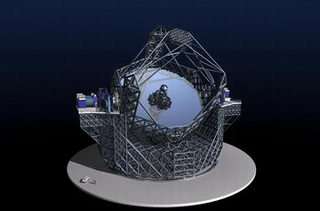
European astronomy has received a tremendous boost with the decision from ESO's governing body to proceed with detailed studies for the European Extremely Large Telescope. This study, with a budget of 57 million euro, will make it possible to start, in three years time, the construction of an optical/infrared telescope with a diameter around 40m that will revolutionise ground-based astronomy. The chosen design is based on a revolutionary concept specially developed for a telescope of this size.
"The decision by the ESO Council to go ahead with the design study for an European Extremely Large Telescope is a very exciting one for European astronomy,", said Richard Wade, President of the ESO Council.
"Today is a great day because the ESO Council has authorised us to go forward with the final design of the next flagship telescope of ESO,", says Catherine Cesarsky, ESO's Director General.
Since the end of last year, ESO has been working together with its user community of European astronomers and astrophysicists to define the new giant telescope needed by the middle of the next decade. More than one hundred astronomers from all European countries have been involved throughout 2006, helping the ESO Project Offices to produce a novel concept, in which performance, cost, schedule and risk were carefully evaluated.
The current generation of 4 to 10-m telescopes have provided astronomers with an incredible wealth of knowledge about our Universe, with the discovery of hundreds of extra-solar systems - some of which have quite amazing properties - and the study of galaxies located extremely far away, whose light comes almost from the very first epoch in the Universe when stars and galaxies started to form. Even more breathtaking is the recent evidence that nearly all the content of our Universe is made of dark matter, whose nature is as yet unknown, and dark energy, the very existence of which is presently not understood. These discoveries pose many new questions that future generation of ELTs should be able to answer. The combination of unprecedented acuity and light gathering power will provide unique images of objects at all scales, from those in our own solar system and exoplanetary systems to the very first points of light in our Universe. Moreover, detailed spectral analysis will reveal invaluable information on their nature, motions and characteristics.
This fast pace has also been possible thanks to early conceptual studies in Europe (such as the ESO OWL and the EURO-50 studies) and research and development done in collaboration with a large number of European institutes and high-tech industries to develop critical enabling technologies within the framework of the EU FP6 programme and with significant contributions from all partners.
Provisionally dubbed E-ELT for the European Extremely Large Telescope, ESO's innovative concept was presented in detail two weeks ago to more than 250 European astronomers at a conference in Marseille. Their enthusiastic welcome paved the way for the decision by the ESO Council to move to the crucial next phase: detailed design of the full facility.
"At the end of the three year Final Design Study, we will know exactly how everything is going to be built including a detailed costing," said Cesarsky. "We then hope to start construction and have it ready by 2017, when we can install instruments and use it!"
The present concept, estimated to cost around 800 million euro, features as a baseline a telescope with a 42-m diameter mirror, and is revolutionary.
"A telescope of this size could not be built without a complete rethinking of the way we make telescopes," said Catherine Cesarsky.
The primary 42-m diameter mirror is composed of 906 hexagonal segments, each 1.45 m in size, while the secondary mirror is as large as 6 m in diameter. In order to overcome the fuzziness of stellar images due to atmospheric turbulence the telescope needs to incorporate adaptive mirrors into its optics. A tertiary mirror, 4.2 m in diameter, relays the light to the adaptive optics system, composed of two mirrors: a 2.5-m mirror supported by 5000 or more actuators able to distort its own shape a thousand times per second, and one 2.7 m in diameter that allows for the final image corrections. This five mirror approach results in an exceptional image quality, with no significant aberrations in the field of view.
The site of the E-ELT is not yet fixed as studies are still undergoing with a plan to make a decision by 2008.
Extremely Large Telescopes are considered worldwide as one of the highest priorities in ground-based astronomy. They will vastly advance astrophysical knowledge, allowing detailed studies of subjects including planets around other stars, the first objects in the Universe, super-massive Black Holes, and the nature and distribution of the dark matter and dark energy which dominate the Universe.
With a diameter of 42 m and its adaptive optics concept, the E-ELT will be more than one hundred times more sensitive than the present-day largest optical telescopes, such as the 10-m Keck telescopes or the 8.2-m VLT telescopes.
"This is really the beginning of a new era for optical and infrared astronomy," said Catherine Cesarsky.
Source: ESO


