Negative Vibes From Space
December 1, 2006

Negative Vibes From Space

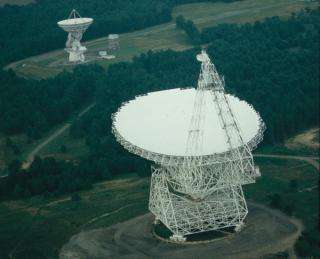
Green Bank Telescope. Credit: NRAO

Astronomers have discovered the first negatively charged molecule in space, identifying it from radio signals that were a mystery until now. While about 130 neutral and 14 positively charged molecules are known to exist in interstellar space, this is the first negative molecule, or anion, to be found.

"We've spotted a rare and exotic species, like the white tiger of space," said astronomer Michael McCarthy of the Harvard-Smithsonian Center for Astrophysics (CfA).

By learning more about the rich broth of chemicals found in interstellar space, astronomers hope to explain how the young Earth converted these basic ingredients into the essential chemicals for life. This new finding helps to advance scientists' understanding of the chemistry of the interstellar medium, and hence the birthplaces of planets.

McCarthy worked with CfA colleagues Carl Gottlieb, Harshal Gupta (also from the Univ. of Texas), and Patrick Thaddeus to identify the molecular anion known as C6H-: a linear chain of six carbon atoms with one hydrogen atom at the end and an "extra" electron. Such molecules were thought to be extremely rare because ultraviolet light that suffuses space easily knocks electrons off molecules. The large size of C6H-, larger than most neutral and all positive molecules known in space, may increase its stability in the harsh cosmic environment.

"The discovery of C6H- resolves a long-standing enigma in astrochemistry: the apparent lack of negatively charged molecules in space," stated Thaddeus.

The team first conducted laboratory experiments to determine exactly what radio frequencies to use in their search. Then, they used the National Science Foundation's Robert C. Byrd Green Bank Telescope to hunt for C6H- in celestial objects. In particular, they targeted locations in which previous searches had spotted unidentified radio signals at the appropriate frequencies.

They found C6H- in two very different locations-a shell of gas surrounding the evolved red giant star IRC +10216 in the constellation Leo, and the cold molecular cloud TMC-1 in Taurus. The presence of the anion in both regions shows that the chemical processes that form C6H- are ubiquitous. It also suggests that other molecular anions are present and will be found in the near future.

"This finding is dramatic evidence that our understanding of interstellar chemistry is still quite rudimentary. It also implies that more molecular anions, perhaps many, may now be found in the laboratory and in space," said McCarthy.

This research will appear in the December 1 issue of The Astrophysical Journal Letters.

Source: Harvard-Smithsonian Center for Astrophysics

4.5 /5 (75 votes)  

Rank 4.5 /5 (75 votes)
Tags

Relevant PhysicsForums posts
  • Hubble Law - recession velcoity???
    created7 hours ago
  • Earth's magnetosphere historical data
    createdMay 14, 2012
  • how much would a laser spread out in space?
    createdMay 14, 2012
  • Gamma Ray Bursters vs Quasars?
    createdMay 14, 2012
  • is there any "gravitationally unbound' galactic clusters in observable universe
    createdMay 12, 2012
  • How WMAP satellite surveyed all over observable universe
    createdMay 12, 2012
  • More from Physics Forums - General Astronomy

More news stories

Preparing for a Martian climbing trip

In August, NASA's Mars Science Laboratory will reach the Red Planet and begin its search for habitats that could have supported life.

Space & Earth / Space Exploration

created 17 minutes ago | popularity not rated yet | comments 0

Chocolate and diamonds: Why volcanoes could be a girl's best friend

Scientists from the University of Southampton have discovered a previously unrecognised volcanic process, similar to one that is used in chocolate manufacturing, which gives important new insights into the ...

Space & Earth / Earth Sciences

created 4 hours ago | popularity 5 / 5 (1) | comments 0 | with audio podcast

Astronomers discovered ancient Egyptian observations of a variable star

The study of the "Demon star", Algol, made by a research group of the University of Helsinki, Finland, has received both scientific and public attention. The period of the brightness variation of this eclipsing binary star ...

Space & Earth / Space Exploration

created 4 hours ago | popularity 5 / 5 (2) | comments 0 | with audio podcast

ViviSat space vehicles will keep satellites on track

(Phys.org) -- A company that aims to sell satellite protective services is eagerly stating its business case to geosynchronous satellite operators that can benefit from its approach toward orbit mission extension. ...

Space & Earth / Space Exploration

created 9 hours ago | popularity 5 / 5 (1) | comments 4 | with audio podcast report

A deeper look at Centaurus A

(Phys.org) -- The strange galaxy Centaurus A is pictured in a new image from the European Southern Observatory. With a total exposure time of more than 50 hours this is probably the deepest view of this peculiar ...

Space & Earth / Astronomy

created 6 hours ago | popularity not rated yet | comments 0 | with audio podcast


IPhone to get larger screen: A report to take with a grain of salt?

Apple has begun preparing to launch an iPhone with a larger screen than its previous models, according to a report in the Wall Street Journal.

Healthy eating can cost less, study finds

Is it really more expensive to eat healthy? An Agriculture Department study released Wednesday found that most fruits, vegetables and other healthy foods cost less than foods high in fat, sugar and salt.

"Social Network" writer to pen Steve Jobs film script

Sony Pictures Entertainment on Wednesday said that the Academy Award winning screenwriter behind "The Social Network" will write the script for a film about Apple co-founder Steve Jobs.

NY tech fest heralds Silicon Valley of the East

The Big Apple may not have California's weather, but tech fans at New York Internet Week say that in every other way the city is on course to become Silicon Valley 2.0.

How do consumers achieve self-affirmation when purchasing products?

People who feel good about themselves are less likely to choose an attractive product than a functional one, according to a new study in the Journal of Consumer Research. But choosing highly aesthetic products may make p ...

Trusting Tiger Woods: How do facial cues affect preference and trust?

People respond to facial cues and this affects their level of trust, according to a new study in the Journal of Consumer Research that looks at the way consumers react to morphed photo images.