Serengeti Patrols Cut Poaching of Buffalo, Elephants, Rhinos
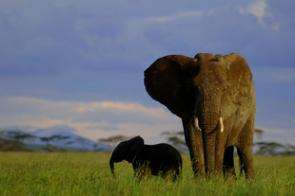
A technique used since the 1930s to estimate the abundance of fish has shown for the first time that enforcement patrols are effective at reducing poaching of elephants, African buffaloes and black rhinos in the Serengeti National Park in Tanzania.
"Wildlife within protected areas is under increasing threat from the bushmeat and illegal trophy trades, and many argue that enforcement within protected areas is not sufficient to protect wildlife. Some say the $2 million spent annually in the Serengeti on patrols would be better spent on other preventive activities," says Ray Hilborn, University of Washington professor of aquatic and fishery sciences and lead author of a paper in the Nov. 24 issue of Science.
The 5,700-square-mile Serengeti is one of Africa's most pristine preserves.
"The animals are 'telling' us poaching is down now that there are 10 to 20 patrols a day compared to the mid-1980s when there might be 60 or fewer patrols a year," Hilborn says. They tell us, he says, by increasing in abundance, something that can measured using aerial surveys.
It's been impossible to actually count the number of animals that are poached because poaching is illegal and most animals – apart from elephants and rhinos which are traditionally not eaten – are caught in snares set by local villagers for their own use or sale. A recent article in National Geographic, for example, said estimates of the poaching toll range as high as 200,000 in the Serengeti. Hilborn says that poaching cannot be nearly that great or the populations still would be declining.
"The estimates are just all over the place, not just for the Serengeti but all across Africa," Hilborn says. This confounds efforts to learn how best to solve the problem when wildlife numbers decline catastrophically.
So Hilborn and his co-authors employed the catch-per-unit-of-effort technique used for decades by managers to estimate fish abundance and set fishing limits.
Estimates are based on a ratio comparing the number of fish caught in an area with the total number of hours of fishing – the unit-of-effort – by all the vessels in that area.
In the Serengeti, which has a 50-year-record of arrests and patrols, the scientists divided the number of poachers arrested by the number of patrols a day to estimate the amount of poaching. They assumed that arrests per patrol were representative of poaching intensity and not, for instance, that officer training or informant networks improved.
"We show that a precipitous decline in enforcement in 1977 resulted in a large increase in poaching and decline of many species," Hilborn and his co-authors write. "Conversely, expanded budgets and antipoaching patrols since the mid-1980s have significantly reduced poaching and allowed populations of buffalo, elephants and rhinoceros to rebuild."
Outside of established reserves, using tourism or hunting expeditions to generate economic benefits for local communities is the cornerstone to enlisting their help in protecting wildlife, Hilborn says. But the community conservation programs initiated in Tanzania since 2000 occurred after stepped-up patrols in the Serengeti proved effective.
"Antipoaching is effective in protected areas," he says.
The work marks the first time anyone has been able to reconstruct a history of poaching going back as far as 50 years, says Tom Hobbs, professor of ecology at Colorado State University and who is not affiliated with the work being published in Science.
"The Hilborn team has shown that protection of wildlife by active enforcement of laws and regulations remains an essential tool for conserving biological diversity," Hobbs says. "This sounds so simple, but it has been controversial."
Source: University of Washington


