'Nymph of the sea' reveals remarkable brood
Nov 22, 2006
'Nymph of the sea' reveals remarkable brood
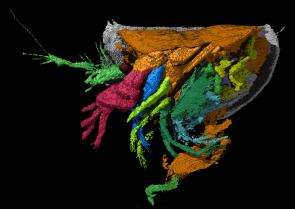
The female fossil ostracod with the shell removed, to show appendages and the eggs (in yellow, at the rear). Credit: University of Leicester

The scientists discovered the mother complete with her brood of some 20 eggs and 2 possible juveniles inside, together with other details of her soft part anatomy including legs and eyes.

The research team consisted of David Siveter from the University of Leicester, Derek Siveter from Oxford, Mark Sutton from Imperial College London and Derek Briggs from Yale.

The team has made a digital image of the fossil - an ostracod (a relative of the shrimps) - which is preserved exceptionally in volcanic ash rocks in Herefordshire. Their findings are published on line in the Proceedings of the Royal Society.

Professor David Siveter, of the Department of Geology at the University of Leicester, said : "Ostracods are common, pin-head sized crustaceans known from thousands of living species in garden ponds to oceans and from countless fossil shells up to 500 million years old; however, their fossilized soft-parts are exceedingly rare.

"Supposed examples of fossil invertebrate eggs are also few. The fossil we have found contains soft-part anatomy such as legs and eyes and also includes about twenty eggs, each about half a millimetre in size, and two possible juveniles.

"The fossil has been christened Nymphatelina gravida, meaning' a pregnant young woman of the sea'. This remarkable discovery provides an unequivocal and unique view of parental brood care in the invertebrate fossil record, it allows gender to be determined in an animal as old as the Silurian period of geological time, and indicates a remarkably conserved egg brooding reproductive strategy."

Source: University of Leicester

Explore further: Actor Johnny Depp immortalized in ancient fossil find

add to favorites email to friend print save as pdf

Related Stories

Researchers reveal remarkable fossil

Mar 24, 2011

Researchers from China, Leicester and Oxford have discovered a remarkable fossil which sheds new light on an important group of primitive sea creatures.

Iconic T.rex to be Unveiled at University of Leicester

Oct 27, 2008

(PhysOrg.com) -- A cast of a 21-foot long Tyrannosaurus rex dinosaur (a rare, sub-adult individual), commissioned from the makers of specimens of T. rex that featured in the film ‘Jurassic Park’ is to go on permanent ...

Unique fossils capture 'Cambrian migration'

Oct 10, 2008

(PhysOrg.com) -- A unique set of fossils indicates that 525 million years ago marine animals congregated in Earth’s ancient oceans, most likely for migration, according to an international team of scientists.

Recommended for you

The eloquence of the otoliths

May 16, 2013

Fish fossils that are about 23 million years old give unprecedented insight into the evolutionary history of the gobioid order, one of the most species-rich groups among the modern bony fishes.

Light cast on lifestyle and diet of first New Zealanders

May 16, 2013

(Phys.org) —A University of Otago-led multidisciplinary team of scientists have shed new light on the diet, lifestyles and movements of the first New Zealanders by analysing isotopes from their bones and teeth.

mtDNA study shows Minoans came from Europe not Africa

May 15, 2013

(Phys.org) —A new study conducted by a team of American and Greek researchers has found that the people of the ancient Minoan civilization living on the island of Crete most likely came from Europe. In ...

User comments : 0

More news stories

Temporal processing in the olfactory system

The neural machinery underlying our olfactory sense continues to be an enigma for neuroscience. A recent review in Neuron seeks to expand traditional ideas about how neurons in the olfactory bulb might encode information about ...

US seizes Bitcoin operator accounts

US authorities seized the accounts of a Bitcoin digital currency exchange operator, claiming it was functioning as an "unlicensed money service business," court documents showed Friday.