Volcanic eruptions found to poke holes in ozone layer
Nov 08, 2006
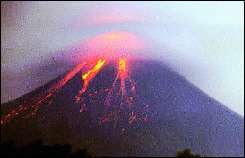
The Mount Merapi volcano spews lava

Volcanic eruptions destroy ozone and create ‘mini-ozone holes’, according to two new studies by researchers at the Universities of Cambridge and Oxford.

The new research, spearheaded by Dr Genevieve Millard at the Department of Earth Sciences, University of Cambridge, discovered that volcanic gases released during eruptions accelerate reactions that lead to ozone destruction. The researchers found that even relatively small volcanic eruptions can destroy ozone and create localised ‘holes’ in the stratosphere.

Previously, scientists had concentrated on the climatic effects of the tiny particles of volcanic sulphate created from the sulphur dioxide gas emitted during an eruption. For the first time, analysing data from a 2000 eruption of the Hekla volcano, Iceland, the researchers discovered that volcanic gases may also lead to the formation of ice and nitric acid particles. This is a critical finding as these particles ‘switch on’ volcanic chorine gases, accelerating reactions that lead to ozone destruction.

Dr Millard said: 'We have shown for the first time that volcanic eruptions which penetrate the stratosphere can lead to the formation of the type of clouds that promote reactions with volcanic chlorine gases - gases that destroy stratospheric ozone and lead to the formation of "mini-ozone holes".

The ozone losses due to the small eruption at Hekla lasted for about two weeks, and eventually returned to normal levels. This is the first time that people have observed the complete removal of local ozone following a volcanic eruption.

'Now we want to find out what might happen to the ozone layer after a much larger eruption', said Dr David Pyle, University of Oxford, project coordinator, 'for example is there significant loss of ozone, and increased ultra-violet radiation, at low latitudes following large explosive eruptions? We want to understand this, so that we can have a better picture both of what might have happened in the past, and of what may happen in the future.'

Citation: Millard G. A., T. A. Mather, D. M. Pyle, W. I. Rose, B. Thornton (2006), Halogen emissions from a small volcanic eruption: Modeling the peak concentrations, dispersion, and volcanically induced ozone loss in the stratosphere, Geophys. Res. Lett., 33, L19815, doi:10.1029/2006GL026959.

Source: University of Oxford

Explore further: Alaska volcano shoots ash 15,000 feet into the air

add to favorites email to friend print save as pdf

Related Stories

Ancient Earth crust stored in deep mantle

Apr 24, 2013

Scientists have long believed that lava erupted from certain oceanic volcanoes contains materials from the early Earth's crust. But decisive evidence for this phenomenon has proven elusive. New research from ...

Volcanic gases could deplete ozone layer: research

Jun 12, 2012

Giant volcanic eruptions in Nicaragua over the past 70,000 years could have injected enough gases into the atmosphere to temporarily thin the ozone layer, according to new research. And, if it happened today, ...

Aerosols: From Ash in the Wind to Smoke from the Stack

Apr 16, 2010

(PhysOrg.com) -- When we hear the word "aerosol," most of us think of spray cans and perhaps the ozone hole. But spray cans are just a very small part of the story. Any airborne solid particle or liquid droplet ...

Violent Nabro eruption shown to pierce stratosphere

Feb 08, 2013

(Phys.org)—Researchers from the U.S. Naval Research Laboratory Ocean and Atmospheric Science and Technology Directorate report conclusive evidence that volcanic gases and aerosols from the explosive 2011 ...

ESA declares end of mission for Envisat satellite

May 09, 2012

Just weeks after celebrating its tenth year in orbit, communication with the Envisat satellite was suddenly lost on 8 April. Following rigorous attempts to re-establish contact and the investigation of failure ...

Recommended for you

Alaska volcano shoots ash 15,000 feet into the air

May 18, 2013

(AP)—One of Alaska's most restless volcanoes has shot an ash cloud 15,000 feet into the air in an ongoing eruption that has drawn attention from a nearby community but isn't expected to threaten air traffic.

NASA sees Cyclone Mahasen hit Bangladesh

May 17, 2013

NASA's Tropical Rainfall Measuring Mission satellite known as TRMM measured Cyclone Mahasen's rainfall rates from space as it made landfall on May 16. Mahasen has since dissipated over eastern India.

Rapid climate change ruled out ice age trees

May 17, 2013

Short, sharp fluctuations in the Earth's climate throughout the last ice age may have stopped trees from getting a foothold in Europe and northern Asia, scientists say.

Earth's iron core is surprisingly weak, researchers say

May 17, 2013

The massive ball of iron sitting at the center of Earth is not quite as "rock-solid" as has been thought, say two Stanford mineral physicists. By conducting experiments that simulate the immense pressures deep in the planet's ...

User comments : 0

More news stories

Galaxy's Ring of Fire

Johnny Cash may have preferred this galaxy's burning ring of fire to the one he sang about falling into in his popular song. The "starburst ring" seen at center in red and yellow hues is not the product of ...

Earth's center is out of sync

(Phys.org) —We all know that the Earth rotates beneath our feet, but new research from ANU has revealed that the center of the Earth is out of sync with the rest of the planet, frequently speeding up and ...