Spider spin doctor says arachnids getting bad rap
Halloween is a time when people don't seem to mind decorating their doorways with spider webs. But during the rest of the year, eight-legged creatures are on the wrong end of some bad press, according to one University of Alberta graduate student.
"I'm not sure I totally understand arachnophobia, but it's been a part of Halloween for such a long time," said Tyler Cobb who teaches Conservation and Management of Endangered Species (ENCS 464) at the U of A. "I think the way spiders get treated in movies is unfair. Moviemakers are just tapping into that fear of the unknown, but usually when people learn about spiders - what they're really like - that fear starts to go away."
Cobb uses spiders to help his students understand that all creatures - even those that aren't cute and cuddly - deserve respect and protection. When Cobb sees a spider in his home, he's not one to reach for the rolled-up newspaper.
"I just think it's cool. I'm totally fascinated by spiders," he said. "There seems to be a fear of them, an innate fear, and I don't know where that comes from. I think every kid starts off with that bug fascination phase and then, somewhere along the line, that curiosity about the unknown becomes fear of the unknown."
For the past few years, Cobb has been using live tarantulas and other cool creepy crawlies (scorpions, mantids, etc.) as part of laboratory demonstrations in the ENCS 464 class. He's been attempting to "spread the word" about the importance of invertebrates in conservation and ecology, dispel myths, and assist students in getting over their fears.
"For example, with careful encouragement, we are regularly able to get someone who is terribly afraid of spiders to hold a large live tarantula and leave with a new understanding and interest in these animals," he said. "Occasionally, through education, we can give that childhood fascination back to them, such that they look at the invertebrates in their own back yard with a more sympathetic eye. In the long run, this can lead to increased awareness about biodiversity conservation."
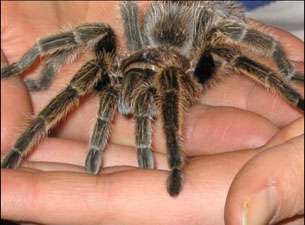
'Rosie,' the rosehair tarantula who makes regular appearances in Cobb's classroom, has helped a lot of students reclaim their natural curiosity.
"There are all sorts of myths out there about tarantulas being lethal, but it's a big spider. It's normal to be nervous," said Cobb. "By handling Rosie ourselves and letting it walk across our hands, we can convince students who are nervous to give it a try. Usually, those students who are not really afraid will start handing Rosie, and then eventually you can get students who are deathly afraid of spiders to handle her with a glove on."
"By the end of the class, you occasionally get that magical moment where somebody who's totally afraid of spiders, who didn't even want to be in the room, is willing to handle Rosie and leaves with a new awareness of how cool spiders really are."
Cobb says he just never outgrew his fascination with bugs of all kinds. Although most of his own studies focus on beetles, spiders hold a special lure for him.
"When you start to look at the details of their lifestyle and their behaviours, how they look, the things they eat and their role in the ecosystems, respect builds on that," he said. "I love the way tarantulas walk - they're so slow and methodical. Jumping spiders move very, very quickly, they just leap on their prey. Something like the ballooning behaviour is absolutely incredible. Baby spiders will leave the nest by spinning little bits of web that catch the wind and disperse them - when you're walking in the woods and you feel that little bit of web on your face, that's probably from ballooning."
While leaping and flying spiders might not put the fears of an arachnophobe to rest, Cobb points to helpful behaviours such as helping to control mosquito populations as reasons to gently release the next eight-legged visitor outside instead of reaching for the Raid.
"It would be nice if they could get people to look at spiders like they look at other cute and furry creatures and offer them some respect," said Cobb. "We're trying to get people interested in the conservation of these poorly studied organisms. We use these big, showy invertebrates, like the tarantula, to raise people's awareness about the spiders and beetles in their own back yards. In the process we get to help people get over their fears."
Source: University of Alberta


