San Jacinto Fault Younger than Thought, with Faster Slip Rate
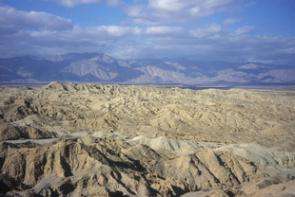
A detailed study of sedimentary rocks exposed along a portion of southern California’s San Jacinto fault zone shows the fault to be no older than 1.1 million to 1.3 million years and that its long-term slip rate is probably faster than previously thought.
Researchers at three universities conducted a National Science Foundation-funded study of the earthquake-active region, concluding that sedimentation related to slip in the San Jacinto fault zone began about 1 million years ago, significantly later than predicted by many models for faulting in southern California. Their findings appear in the November-December issue of the Geological Society of America Bulletin.
“Our findings suggest that the San Jacinto fault absorbs a large share of the relative motion between the Pacific and North American plates,” said principal investigator Rebecca J. Dorsey, a professor of geological sciences at the University of Oregon. “This is important both for understanding the development of this active plate boundary and for helping to constrain estimates of seismic hazards in southern California.”
Until now the birth of the San Jacinto fault in the area of Anza-Borrego Desert State Park had not been pinned down. Geologists from the University of Oregon, Western Washington University and Utah State University carried out detailed geologic mapping, measuring and analysis of samples from Pleistocene (12,000 to 1.8 million years ago) sedimentary rocks in the western Salton Trough, including the Ocotillo Formation and the Font’s Point Sandstone in the Borrego Badlands.
Using geologic, stratigraphic and paleomagnetic techniques, they determined that sedimentation related to slip in this fault zone began about 1 million years ago; the fault itself could have started a little earlier than that. A second fault reorganization about 400,000 years later produced a thin sheet-like alluvial deposit that created the Font’s Point Sandstone, triggering modern uplift and erosion that has produced the popular Font’s Point escarpment.
“The revised younger age of the San Jacinto fault indicates it is an important player in southern California’s seismically active fault zones,” Dorsey said.
However, she noted, “a rigorous assessment of long-term slip rate on this fault must await a complete analysis of the total offset on the fault,” which already is underway. “Based on our current knowledge, it appears that the geologic slip rate could be as high as about 20 millimeters a year,” she said.
Slip rate is the speed at which one side of a fault moves with respect to the other. Any rate over 10 millimeters a year is considered “fast,” although the movement measured is an average occurring over long periods of time and many earthquakes. Previous studies concluded that fault has slipped about 25 kilometers (15.5 miles) in a right-lateral sense, at a rate of 10-12 millimeters a year during the last 2.0 million to 2.4 million years.
Source: University of Oregon


