Study: Dust may dampen hurricane fury
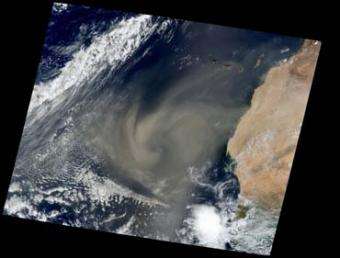
After more than a dozen hurricanes battered the Atlantic Ocean last year, scientists are wondering what — if anything — might be causing stronger and more frequent storms. Some have pointed to rising ocean temperatures, brought on by global warming. Others say the upswing is simply part of a natural cycle in which hurricanes get worse for a decade or two before dying down again.
Now, researchers at the University of Wisconsin-Madison have put forward an intriguing theory that introduces a whole new dimension to the debate.
Writing Oct. 11 in the journal Geophysical Research Letters, the scientists discuss a surprising link between hurricane frequency in the Atlantic and thick clouds of dust that periodically rise from the Sahara Desert and blow off Africa's western coast.
Lead author Amato Evan, a researcher at UW-Madison's Cooperative Institute for Meteorological Satellite Studies (CIMSS), pored over 25 years of satellite data — dating from 1981-2006 — and noticed the correlation. During periods of intense hurricane activity, he found, dust was relatively scarce in the atmosphere. In years when stronger dust storms rose up, on the other hand, fewer hurricanes swept through the Atlantic.
"These findings are important because they show that long-term changes in hurricanes may be related to many different factors," says co-author Jonathan Foley, director of UW-Madison's Center for Sustainability and the Global Environment. "While a great deal of work has focused on the links between [hurricanes] and warming ocean temperatures, this research adds another piece to the puzzle."
If scientists conclusively prove that dust storms help to squelch hurricanes, weather forecasters could one day begin to track atmospheric dust, factoring it into their predictions for the first time.
Researchers have increasingly turned their attention to the environmental impact of dust, after it became clear that in some years, many million tons of sand rise up from the Sahara Desert and float right across the Atlantic Ocean, sometimes in as few as five days.
"People didn't understand the potential impact of dust until satellites allowed us to see how incredibly expansive these dust storms can be," says Evan. "Sometimes during the summer, sunsets in Puerto Rico are beautiful because of all the dust in the sky. Well, that dust comes all the way from Africa."
The Sahara sand rises when hot desert air collides with the cooler, dryer air of the Sahel region — just south of the Sahara — and forms wind. As particles swirl upwards, strong trade winds begin to blow them west into the northern Atlantic. Dust storms form primarily during summer and winter months, but in some years — for reasons that aren't understood — they barely form at all.
Evan decided to explore the correlations between dust and hurricane activity after CIMSS research scientist Christopher Velden and others suggested that dust storms moving over the tropical North Atlantic might be able to suppress the development of hurricanes.
The UW-Madison researchers say that makes sense because dry, dust-ridden layers of air probably helps to "dampen" brewing hurricanes, which need heat and moisture to fuel them. That effect, Velden adds, could also mean that dust storms have the potential to shift a hurricane's direction further to the west, which unfortunately means it would have a higher chance of hitting U.S. land.
While the UW-Madison work doesn't confirm that dust storms directly influence hurricanes, it does provide compelling evidence that the two phenomena are linked in some way. "What we don't know is whether the dust affects the hurricanes directly, or whether both [dust and hurricanes] are responding to the same large scale atmospheric changes around the tropical Atlantic," says Foley. "That's what future research needs to find out."
Jason Dunion of the National Oceanic and Atmospheric Administration's Hurricane Research Division also contributed to the study.
Source: by Paroma Basu, University of Wisconsin-Madison


