Amazing Andromeda Galaxy
Oct 03, 2006
Amazing Andromeda Galaxy
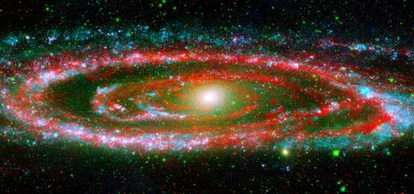
The Andromeda galaxy, in a new composite image from NASA´s Galaxy Evolution Explorer and the Spitzer Space Telescope. Image credit: NASA/JPL-Caltech

The many "personalities" of our great galactic neighbor, the Andromeda galaxy, are exposed in this new composite image from NASA's Galaxy Evolution Explorer and the Spitzer Space Telescope.

The wide, ultraviolet eyes of Galaxy Evolution Explorer reveal Andromeda's "fiery" nature -- hotter regions brimming with young and old stars. In contrast, Spitzer's super-sensitive infrared eyes show Andromeda's relatively "cool" side, which includes embryonic stars hidden in their dusty cocoons.

Galaxy Evolution Explorer detected young, hot, high-mass stars, which are represented in blue, while populations of relatively older stars are shown as green dots. The bright yellow spot at the galaxy's center depicts a particularly dense population of old stars.

Swaths of red in the galaxy's disk indicate areas where Spitzer found cool, dusty regions where stars are forming. These stars are still shrouded by the cosmic clouds of dust and gas that collapsed to form them.

Together, Galaxy Evolution Explorer and Spitzer complete the picture of Andromeda's swirling spiral arms. Hints of pinkish purple depict regions where the galaxy's populations of hot, high-mass stars and cooler, dust-enshrouded stars co-exist.

Located 2.5 million light-years away, the Andromeda is our largest nearby galactic neighbor. The galaxy's entire disk spans about 260,000 light-years, which means that a light beam would take 260,000 years to travel from one end of the galaxy to the other. By comparison, our Milky Way galaxy's disk is about 100,000 light-years across.

This image is a false color composite comprised of data from Galaxy Evolution Explorer's far-ultraviolet detector (blue), near-ultraviolet detector (green), and Spitzer's multiband imaging photometer at 24 microns (red).

Source: NASA, by Whitney Clavin

Explore further: Final curtain for Europe's deep-space telescope

add to favorites email to friend print save as pdf

Related Stories

Stacking galactic signals reveals a clearer universe

Jun 12, 2013

Very similar to stacking astronomy images to achieve a better picture, researchers from the International Centre for Radio Astronomy Research (ICRAR) are employing new methods which will give us a clearer ...

Image: Hubble sees a swirl of star formation

May 27, 2013

(Phys.org) —This beautiful, glittering swirl is named, rather un-poetically, J125013.50+073441.5. A glowing haze of material seems to engulf the galaxy, stretching out into space in different directions ...

'Population census' of galaxies buried in dust

May 31, 2013

A research team led by Bunyo Hatsukade, a postdoc researcher, and Kouji Ohta, a professor, both from the Graduate School of Science, Kyoto University, revealed that approximately 80% of the unidentifiable ...

Recommended for you

Final curtain for Europe's deep-space telescope

13 hours ago

The deep-space telescope Herschel took its final bow on Monday, climaxing a successful four-year mission to observe the birth of stars and galaxies, the European Space Agency (ESA) said.

Hubble spots a very bright contortionist

18 hours ago

(Phys.org) —The contorted object captured by Hubble in this picture is IRAS 22491-1808, also known as the South America Galaxy. It is an ultra-luminous infrared galaxy (ULIRG) that emits a huge amount of ...

Study explains decades of black hole observations

Jun 14, 2013

(Phys.org) —A new study by astronomers at NASA, Johns Hopkins University and Rochester Institute of Technology confirms long-held suspicions about how stellar-mass black holes produce their highest-energy ...

User comments : 0

More news stories

Predators affect the carbon cycle, researchers show

A new study shows that the predator-prey relationship can affect the flow of carbon through an ecosystem. This previously unmeasured influence on the environment may offer a new way of looking at biodiversity management and ...

Final curtain for Europe's deep-space telescope

The deep-space telescope Herschel took its final bow on Monday, climaxing a successful four-year mission to observe the birth of stars and galaxies, the European Space Agency (ESA) said.

New language discovery reveals linguistic insights

A new language has been discovered in a remote Indigenous community in northern Australia that is generated from a unique combination of elements from other languages. Light Warlpiri has been documented by University of Michigan ...