From Shuttle to Orion
Oct 02, 2006
From Shuttle to Orion
Photo credit: NASA

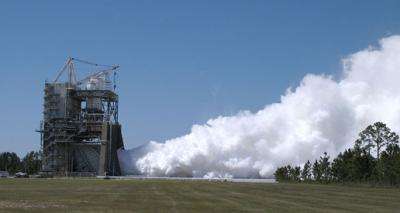
NASA is marking a historic moment in the life of the nation's largest rocket engine test complex. The Stennis Space Center conducted the final space shuttle main engine test on its A-1 Test Stand on Friday, Sept. 29. Although this ends the stand's work on the Space Shuttle Program, it will soon be used for the rocket that will carry America’s next generation human spacecraft, Orion.

The A-1 Test Stand was the site of the first test on a shuttle main engine in 1975. Stennis will continue testing shuttle main engines on its A-2 Test Stand through the end of the Space Shuttle Program in 2010.

The A-1 stand begins a new chapter in its operational history in October. It will be temporarily decommissioned to convert it for testing the J-2X engine, which will power the upper stage of NASA's new crew launch vehicle, the Ares I. The J-2X will also power the Earth departure stage of the Ares V new cargo launch vehicle. The Ares I and V vehicles will provide the thrust, while the Orion crew capsule will be future astronauts’ home in space.

"This is truly an important milestone for Stennis," said Don Beckmeyer, space shuttle main engine project manager in the Test Projects Office of Stennis’ Project Directorate. "As we transition the A-1 Test Stand from testing shuttle main engines to testing J-2X engines, we are entering into some exciting years ahead where our work force and the center as a whole will be key in the development of this new engine. Until the shuttle engines are retired in 2010, we will have two critical test programs running side by side."

Beckmeyer and other engineers have praised the foresight of NASA's early management, whose vision still allows the rugged structures to meet current and future rocket engine testing needs.

"Reaching these milestones is really a testament to the designers and builders of the test stands back in the 1960s," Beckmeyer said. "They were built to last, and their longevity and flexibility are key assets to the agency. We are about to embark on the third generation of rocket engines to be tested on A-1, and we fully expect this test stand to be instrumental in developing and certifying these engines for years to come."

A-1 and its sister stand A-2 were built in the 1960s to test the stages of the Apollo Program's rocket engines, then modified in the 1970s to test-fire and prove flight-worthy all main engines for NASA's space shuttle fleet.

According to Beckmeyer and Gary Benton, Stennis’ J-2X engine project manager, A-1 is set to be reactivated in the spring of 2007.

The J-2X is a modification of the Apollo Program's J-2 engine, which helped send the first Americans to the moon. The original J-2s were also tested at Stennis.

As the A-1 Test Stand moved into the shuttle era, it handled more than 1,000 shuttle main engine tests, which have been crucial to the flight record of the orbiter’s powerful engines. In the 116 launches logged by the shuttle fleet, no main engine has ever experienced a major problem.

Source: NASA

Explore further: Dark, massive asteroid to fly by Earth on May 31

add to favorites email to friend print save as pdf

Related Stories

Hot fire tests steer space launch system engines

Apr 23, 2013

(Phys.org) —Engineers developing NASA's next-generation rocket closed one chapter of testing with the completion of a J-2X engine test series on the A-2 test stand at the agency's Stennis Space Center in ...

Bielefeld robots take part in a space simulation

May 03, 2013

The two robots Flobi and Nao worked full time for three weeks in an isolation study in Cologne. Scientists from Bielefeld University's Research Institute for Cognition and Robotics (CoR-Lab) were studying ...

NASA's asteroid initiative benefits from rich history

Apr 12, 2013

NASA's FY2014 budget proposal includes a plan to robotically capture a small near-Earth asteroid and redirect it safely to a stable orbit in the Earth-moon system where astronauts can visit and explore it. ...

Recommended for you

Dark, massive asteroid to fly by Earth on May 31

18 hours ago

It's 1.7 miles long. Its surface is covered in a sticky black substance similar to the gunk at the bottom of a barbecue. If it impacted Earth it would probably result in global extinction. Good thing it is ...

Research team explains 'Lazarus' comets

21 hours ago

Astronomers from the University of Antioquia have discovered a graveyard of comets. These once-dormant comets, dubbed by astronomers as "The Lazarus comets," are now rejuvenated.

NASA ships sensors for seafaring satellite to France

22 hours ago

(Phys.org) —Three NASA-built instruments that are integral components of the next in a series of U.S./European ocean altimetry satellites have arrived in France for integration with their spacecraft in ...

Trip into space with DiCaprio costs $1.55m

22 hours ago

Leonardo DiCaprio is going to get closer to stars of a different kind as he heads into space aboard the Virgin Galactic, and a well-heeled bidder at the Cannes Film Festival has paid 1.2 million euros (1.5 million) to be ...

User comments : 0

More news stories

Galaxies fed by funnels of fuel

(Phys.org) —Computer simulations of galaxies growing over billions of years have revealed a likely scenario for how they feed: a cosmic version of swirly straws.

Source of life running out: water scientists

The majority of people on Earth people will face severe water shortages within a generation or two if pollution and waste continues unabated, scientists warned at a conference in Bonn Friday.

Dark, massive asteroid to fly by Earth on May 31

It's 1.7 miles long. Its surface is covered in a sticky black substance similar to the gunk at the bottom of a barbecue. If it impacted Earth it would probably result in global extinction. Good thing it is ...

Drones may violate international law

(Phys.org) —As President Obama gives a speech on national security—including defending U.S. use of drones to combat terrorism—Leila Sadat, JD, international law expert and professor of law at Washington University in ...