New study explores role of theater in Maya political organization
Oct 02, 2006
Classic Maya (AD 250-900) Stone Sculpture
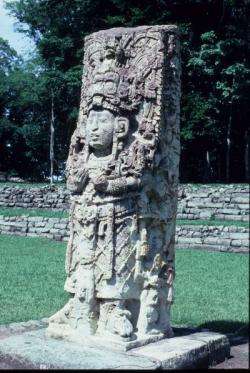
Stela from Copán, Honduras, that depicts the ruler with an elaborate headdress and ornaments. Credit: Courtesy Takeshi Inomata

Magnificent stone sculptures of Classic Maya culture (AD 250-900) have long fascinated archaeologists and the general public alike. But what did the scenes depicted in these monuments mean in their society? In an article to appear in the October 2006 issue Current Anthropology, Takeshi Inomata (University of Arizona) argues that these images commonly show acts of public performance conducted by rulers, revealing the prominent role which state theater played in Maya political organization.

Analyzing plazas where many stone monuments are placed, Inomata suggests that extensive gathering places were a crucial concern in Maya city planning. The spaces were designed to accommodate all of, or a substantial part of, the entire kingdom's population.

Wearing ostentatious feathered headdresses and elaborate costumes, Maya kings danced in these large plazas in front of a large audience. These mass spectacles were occasions in which the general populace shared the experience of witnessing rulers engaged in culturally charged ritual performances, explains Inomata. However, this also meant that rulers were under constant evaluation by their subjects.

"Large-scale theatrical events gave physical reality to a community and helped to ground unstable community identities in tangible forms through the use of symbolic acts and objects," Inomata writes. "The centrality of rulers in communal events suggests that the identities of a Maya community revolved around the images of supreme political leaders. … Large gatherings also gave the elite an opportunity to impose their ideologies and cultural values on the rest of society through performances."

Source: University of Chicago

Explore further: Actor Johnny Depp immortalized in ancient fossil find

add to favorites email to friend print save as pdf

Related Stories

The brain as a model for future supercomputers

31 minutes ago

(Phys.org) —The brain's repute took a big hit in 1997 when an IBM supercomputer defeated world chess champion Gary Kasparov in a match reported around the world. But in the second round, the brain is back.

Realtime map shows Wikipedia changes worldwide

49 minutes ago

(Phys.org) —The show of shows: A realtime map that you can watch, and watch, which displays where in the word people are editing articles for Wikipedia. We are almost tempted to issue a warning here that ...

Android, Samsung extend smartphone lead

1 hour ago

Google's Android mobile operating system grabbed three out of four smartphones sold in the world in the first quarter of 2013, extending its gains over Apple and its iPhone, a survey showed Tuesday.

Recommended for you

The eloquence of the otoliths

May 16, 2013

Fish fossils that are about 23 million years old give unprecedented insight into the evolutionary history of the gobioid order, one of the most species-rich groups among the modern bony fishes.

Light cast on lifestyle and diet of first New Zealanders

May 16, 2013

(Phys.org) —A University of Otago-led multidisciplinary team of scientists have shed new light on the diet, lifestyles and movements of the first New Zealanders by analysing isotopes from their bones and teeth.

mtDNA study shows Minoans came from Europe not Africa

May 15, 2013

(Phys.org) —A new study conducted by a team of American and Greek researchers has found that the people of the ancient Minoan civilization living on the island of Crete most likely came from Europe. In ...

User comments : 0

More news stories

Morocco to harness the wind in energy hunt

Morocco is ploughing ahead with a programme to boost wind energy production, particularly in the southern Tarfaya region, where Africa's largest wind farm is set to open in 2014.

Galaxy's Ring of Fire

Johnny Cash may have preferred this galaxy's burning ring of fire to the one he sang about falling into in his popular song. The "starburst ring" seen at center in red and yellow hues is not the product of ...