Dark Energy and Dark Matter – The Results of Flawed Physics?
Sep 11, 2006 feature
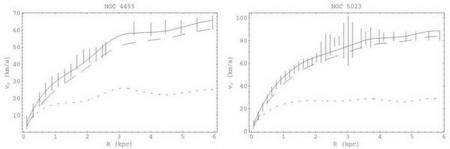
Best fit theoretical rotation curves superimposed on data (dotted lines) from galaxy “NGC 4455” (left) and galaxy “NGC 5023” (right). The solid line is the curve predicted by the new gravity model. Also shown are the Newtonian curve (short dashes) and the Newtonian curve corrected for dark matter (long dashes).

There are few scientific concepts as intriguing and mysterious as dark energy and dark matter, said to make up as much as 95 percent of all the energy and matter in the universe. And even though scientists don't know what either is and have little evidence to prove they exist, dark energy and dark matter are two of the biggest research problems in physics.

But what if they were conceived in error?

This is what three Italian physicists have recently asked. In a paper in the August 3 online edition of the Institute of Physics' peer-reviewed Journal of Cosmology and Astroparticle Physics, they put forth the idea that scientists were forced to propose the existence of dark energy and dark matter because they were, and still are, working with incorrect gravitational theory.

The group suggests an alternative theory of gravity in which dark energy and dark matter are effects – illusions, in a sense – created by the curvature of spacetime (the bending of space and time caused by extremely massive objects, like galaxies). Their theory does not require the existence of dark energy and dark matter.

“Our proposal implies that the 'correct' theory of gravity may be one based solely on directly observed astronomical data,” said lead author Salvatore Capozziello, a theoretical physicist at the University of Naples, to PhysOrg.com.

Dark energy and dark matter were originally conceived to explain, respectively, the accelerating expansion of the universe (despite the tendency of gravity to push matter together) and the discrepancy between the amount of matter scientists expect to observe in the universe but have not yet found. Astronomers suggested the existence of dark matter when they noticed something odd about spiral galaxies: Stars at the middle and edge of a spiral galaxy rotate just as fast as stars near the very center. But according to Newtonian mechanics (the physics of bodies in motion), stars further away from the galactic center should rotate more slowly. Scientists thus assumed that some sort of “dark” matter, not observable by emitted light, must be boosting the total gravity of the galaxy, giving the stars extra rotational speed.

“We can show that no 'exotic' ingredients have to be added to fill the gap between theory and observations,” said Capozziello.

In their paper, he and his co-authors demonstrate this using data from 15 well-studied galaxies. Among this data was each galaxy's “rotation curve,” a graph that plots the rotational speed of the stars in the galaxy as a function of their distance from the galaxy's center. These curves were successfully fit to curves produced using the new theory. Since these 15 galaxies are believed to be dominated by dark matter, fitting their rotation curves using this new gravity model is strong evidence to support an alternative theory of gravity.

Despite this, the notion that dark matter and dark energy are “wrong” is potentially very unpopular. Capozziello and his colleagues are aware that a new theory of gravity impacts the dynamics of the universe as scientists now understand them.

“Any extended theories of gravity must be tested on all the astrophysical scales, ranging from the Solar System to galaxies to galaxy clusters, and all of cosmology,” said Capozziello. “Performing these tests is the cornerstone of our research program.”

Citation: J. Cosmol. Astropart. Phys. 08 (2006) 001.

By Laura Mgrdichian, Copyright 2006 PhysOrg.com

Explore further: The better to see you with: Scientists build record-setting metamaterial flat lens

add to favorites email to friend print save as pdf

Related Stories

'Space warps' project needs your help

May 08, 2013

(Phys.org) —Astronomers are asking volunteers to help them search for "space warps." More commonly known as "gravitational lenses," these are rare systems with very massive galaxies or clusters of galaxies that bend light ...

An anarchic region of star formation

May 02, 2013

(Phys.org) —The Danish 1.54-meter telescope located at ESO's La Silla Observatory in Chile has captured a striking image of NGC 6559, an object that showcases the anarchy that reigns when stars form inside ...

Shining light on elusive dark matter

Apr 04, 2013

The antimatter hunter AMS-02 on the International Space Station is searching for the missing pieces of our Universe. The project's first results published yesterday are hinting at a new phenomenon and revealing more a ...

Recommended for you

Engineers pioneer flat spray-on optical lens

May 23, 2013

A team of researchers, including a University of British Columbia engineer have made a breakthrough utilizing spray-on technology that could revolutionize the way optical lenses are made and used.

User comments : 4

Adjust slider to filter visible comments by rank

Display comments: newest first

Arthur_Dent
1 / 5 (2) Jan 11, 2009
The flaw in their new theory, is that
at least 1 pair of galaxies in collision have shown that dark-mass didn't collide,
but simply passed-through the colliding galaxy,
so the result was
dark-mass/colided-matter-of-2-galaxies/dark-mass.

I believe they used lensing to nail that one, and it was either here on physorg or over on newscientist where that article was posted ( here, I think ).

Their nice "erases dark-mass" theory would have to explain that kind of colision and its lensing, wouldn't it?

Also, there is at least 1 galaxy we've studied that hasn't /got/ dark-matter, so its stars swirl newtonianly.

How would they explain that?

I believe their theory is broken, but don't have the brains to /know/.

Cheers,
smiffy
4 / 5 (2) Jan 11, 2009
Also, there is at least 1 galaxy we've studied that hasn't /got/ dark-matter, so its stars swirl newtonianly.
Do you have a reference for this galaxy?
Dvmx
not rated yet Apr 20, 2009
NGC 4736
http://www.newsci.../dn13280

By the way, the "enlarge image" option for the plotlines picture is not working!
Myria83
1 / 5 (1) Apr 21, 2009
The flaw in their new theory, is that


at least 1 pair of galaxies in collision have shown that dark-mass didn't collide,


but simply passed-through the colliding galaxy,


so the result was


dark-mass/colided-matter-of-2-galaxies/dark-mass.


I believe they used lensing to nail that one, and it was either here on physorg or over on newscientist where that article was posted ( here, I think ).


Their nice "erases dark-mass" theory would have to explain that kind of colision and its lensing, wouldn't it?


Also, there is at least 1 galaxy we've studied that hasn't /got/ dark-matter, so its stars swirl newtonianly.


How would they explain that?


I believe their theory is broken, but don't have the brains to /know/.


Cheers,


Could you specify?

More news stories

Lab sets a new record for creating heralded photons

(Phys.org) —Entanglement, by general consensus of physicists, is the weirdest part of quantum science. To say that two particles, A and B, are entangled means that they are actually two parts of an inseparable ...

Theorists weigh in on where to hunt dark matter

(Phys.org) —Now that it looks like the hunt for the Higgs boson is over, particles of dark matter are at the top of the physics "Most Wanted" list. Dozens of experiments have been searching for them, but ...