New trigger found for volcanic eruptions
Sep 06, 2006
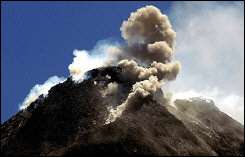
Merapi volcano spews hot thick smoke

New insights into what might trigger the eruption of Mount St Helens and other potentially explosive volcanoes are reported today in Nature by scientists working at the University of Bristol, UK.

Professor Jon Blundy and colleagues show that as magmas crystallise they heat up rather than cool down, as previously thought. And the more a magma crystallises the hotter it gets – by up to 100 °C. This ability to self-heat may provide a trigger for eruptions.

In addition, they show that crystallisation of underground magmas is a short-lived phenomenon – taking years rather than centuries – which is precisely the timescale over which volcanoes can be monitored.

Professor Blundy said: “This work is now being used to gauge the direction of the volcanic activity currently happening at Mount St Helens and could be applied to any active volcano for which monitoring and petrological records are available.”

Dr Madeleine Humphreys added: “Explosive volcanic eruptions are fuelled by the escape of volcanic gases from magma stored in underground reservoirs and pipes several kilometres below the surface. Predicting such eruptions requires a real-time knowledge of just where the magma is at any one time and what it is doing.”

Blundy and colleagues analysed tiny droplets of volcanic liquids that become trapped inside crystals as the magma crystallises on its way to the surface. This enabled them to reconstruct the changes in pressure, temperature and crystallinity that occur within a body of magma prior to eruption. The researchers demonstrate that as pressure decreases, crystallinity increases, and the more a magma crystallises the hotter it gets – by up to 100 °C.

This surprising result indicates that the driving force behind crystallisation of these magmas was a drop in pressure, rather than loss of heat to the surrounding rocks, as previously thought. This raises a number of interesting possibilities for eruption dynamics.

If ascending magma is able to heat itself up, simply by crystallising, this may provide an important trigger for eruption without the need to invoke an extraneous heat source, such as a shot of hotter magma from below.

And because decompression can be effected much more quickly than cooling, which requires slow heat loss through the walls of the magma chamber, the new results raise the possibility that volcanic crystals grow in response to decompression on the unexpectedly short timescale of several years, which is the timescale over which volcanoes are monitored.

This work opens up the possibility of directly linking the monitoring record of active volcanoes to magma crystallisation underground in a fashion not previously possible.

Source: University of Bristol

Explore further: Alaska volcano shoots ash 15,000 feet into the air

add to favorites email to friend print save as pdf

Related Stories

Scientists to Io: Your volcanoes are in the wrong place

Apr 04, 2013

(Phys.org) —Jupiter's moon Io is the most volcanically active world in the Solar System, with hundreds of volcanoes, some erupting lava fountains up to 250 miles high. However, concentrations of volcanic ...

Carbon's role in planetary atmosphere formation

Apr 08, 2013

(Phys.org) —A new study of how carbon is trapped and released by iron-rich volcanic magma offers clues about the early atmospheric evolution on Mars and other terrestrial bodies.

Another link between CO2 and mass extinctions of species

Mar 22, 2013

(Phys.org) —It's has been know that massive increases in emission of CO2 from volcanoes, associated with the opening of the Atlantic Ocean in the end-Triassic Period, set off a shift in state of the climate ...

The 'habitable edge' of exomoons

Mar 05, 2013

Astronomers have their fingers crossed that within the haul of data collected by NASA's Kepler mission, which has already detected nearly three thousand possible exoplanets, hide the signatures of the very ...

Recommended for you

Alaska volcano shoots ash 15,000 feet into the air

19 hours ago

(AP)—One of Alaska's most restless volcanoes has shot an ash cloud 15,000 feet into the air in an ongoing eruption that has drawn attention from a nearby community but isn't expected to threaten air traffic.

NASA sees Cyclone Mahasen hit Bangladesh

May 17, 2013

NASA's Tropical Rainfall Measuring Mission satellite known as TRMM measured Cyclone Mahasen's rainfall rates from space as it made landfall on May 16. Mahasen has since dissipated over eastern India.

Rapid climate change ruled out ice age trees

May 17, 2013

Short, sharp fluctuations in the Earth's climate throughout the last ice age may have stopped trees from getting a foothold in Europe and northern Asia, scientists say.

Earth's iron core is surprisingly weak, researchers say

May 17, 2013

The massive ball of iron sitting at the center of Earth is not quite as "rock-solid" as has been thought, say two Stanford mineral physicists. By conducting experiments that simulate the immense pressures deep in the planet's ...

User comments : 0

More news stories

Galaxy's Ring of Fire

Johnny Cash may have preferred this galaxy's burning ring of fire to the one he sang about falling into in his popular song. The "starburst ring" seen at center in red and yellow hues is not the product of ...

Alaska volcano shoots ash 15,000 feet into the air

(AP)—One of Alaska's most restless volcanoes has shot an ash cloud 15,000 feet into the air in an ongoing eruption that has drawn attention from a nearby community but isn't expected to threaten air traffic.

Chinese, Indian airlines face EU pollution fines

Eight Chinese and two Indian airlines face fines of up to several million euros for not paying for their greenhouse gas emissions during flights within the bloc, the European Commission said on Friday.

Morocco to harness the wind in energy hunt

Morocco is ploughing ahead with a programme to boost wind energy production, particularly in the southern Tarfaya region, where Africa's largest wind farm is set to open in 2014.

US seizes Bitcoin operator accounts

US authorities seized the accounts of a Bitcoin digital currency exchange operator, claiming it was functioning as an "unlicensed money service business," court documents showed Friday.