Rare high-altitude clouds found on Mars
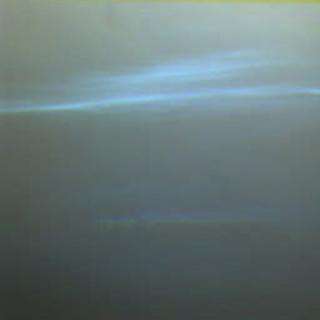
Planetary scientists have discovered the highest clouds above any planetary surface. They found them above Mars using the SPICAM instrument on board ESA's Mars Express spacecraft. The results are a new piece in the puzzle of how the Martian atmosphere works.
Until now, scientists had been aware only of the clouds that hug the Martian surface and lower reaches of the atmosphere. Thanks to data from the SPICAM Ultraviolet and Infrared Atmospheric Spectrometer onboard Mars Express, a fleeting layer of clouds have been discovered at an altitude between 80 and 100 kilometres. The clouds are most likely composed of carbon dioxide.
SPICAM made the discovery by observing distant stars just before they disappeared behind Mars. By looking at the effects on the starlight as it travelled through the Martian atmosphere, SPICAM built up a picture of the molecules at different altitudes. Each sweep through the atmosphere is called a profile.
The first hints of the new cloud layer came when certain profiles showed that the star dimmed noticeably when it was behind the 90–100 kilometre high atmospheric layer. Although this happened in only one percent of the profiles, by the time the team had collected 600 profiles, they were confident that the effect was real.
"If you wanted to see these clouds from the surface of Mars, you would probably have to wait until after sunset" says Franck Montmessin, a SPICAM scientist with Service d'Aeronomie du CNRS, Verrières-le-Buisson, France, and lead author of the results. This is because the clouds are very faint and can only be seen reflecting sunlight against the darkness of the night sky. In that respect, they look similar to the mesospheric clouds, also known as noctilucent clouds, on Earth. These occur at 80 kilometres altitude above our planet, where the density of the atmosphere is similar to that of Mars’ at 35 kilometres. The newly discovered Martian clouds therefore occur in a much more rarefied atmospheric location.
At 90–100 kilometres above the Martian surface, the temperature is just –193° Celsius. This means that the clouds are unlikely to be made of water. "We observe the clouds in super-cold conditions where the main atmospheric component CO2 (carbon dioxide), cools below its condensation point. From that we infer that they are made of carbon dioxide," says Montmessin.
But how do these clouds form? SPICAM has revealed the answer by finding a previously unknown population of minuscule dust grains above 60 kilometres in the Martian atmosphere. The grains are just one hundred nanometres across (a nanometre is one thousand-millionth of a metre).
They are likely to be the 'nucleation centres' around which crystals of carbon dioxide form to make clouds. They are either microscopic chippings from the rocks on the surface on Mars that have been blown to extreme altitudes by the winds, or they are the debris from meteors that have burnt up in the Martian atmosphere.
The new high-altitude cloud layer has implications for landing on Mars as it suggests the upper layers of Mars' atmosphere can be denser than previously thought. This will be an important piece of information for future missions, when using friction in the outer atmosphere to slow down spacecraft (in a technique called 'aerobraking'), either for landing or going into orbit around the planet.
These results are published online in the Icarus scientific magazine (vol. 183, issue 2, August 2006), in the article titled: "Subvisible CO2 ice clouds detected in the mesosphere of Mars", by F.Montmessin, J.L.Bertaux (Service d'Aeronomie du CNRS, Verrières-le-Buisson, France ), et al.
Source: ESA
