Suspicion Confirmed: Flat Molecules Better for Conducting Electricity
Aug 25, 2006
Suspicion Confirmed: Flat Molecules Better for Conducting Electricity
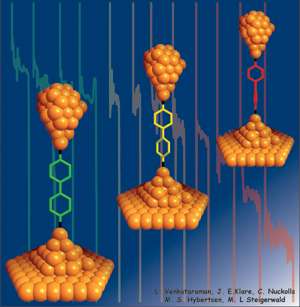
Conductance vs. Conformance: The diagram above illustrates how the conductance of the molecule (the green, yellow or red structure in the center of each model) drops as its two benzene rings are rotated relative to one another. On the far left the molecule is shown in its flattest form, and has the highest conductance. Diagram courtesy of L. Venkataraman.

Columbia research scientist Latha Venkataraman has demonstrated that in creating single-molecule electronic devices, flatter molecules conduct electricity better. That principle has long been suspected, but to demonstrate it definitively required an innovation to existing methods for measuring conductance in nano-scale objects.

The field of nanotechnology involves designing machines and devices on a nanoscale. One of the main challenges for scientists had been in figuring out how to test the conductance of electronic components that consist of a single molecule. Scientists have come up with a number of techniques, but the large fluctuations in the results produced by these techniques have made it difficult to predict how individual molecules will behave as electronic devices.

In her previous research, Venkataraman -- together with her colleagues Jennifer Klare, Colin Nuckolls, Mark Hybertsen and Michael Steigerwald from Columbia’s Nanoscale Science and Engineering Center -- came up with a refinement of one of the prevailing methods for measuring conductance in a molecule. She used a novel amine-gold link to attach single molecules to the gold electrodes (published in Nano Letters in March 2006).

Venkataraman et al. have now applied this technique to provide definitive evidence to support a long-held belief that flatter molecules conduct electricity better than twisted ones.

“Overall, the discovery of the amine-gold link chemistry has been a significant breakthrough in the field of molecular electronics,” said Venkataraman. “It has enabled detailed and systematic studies of single molecule conductance as a function of molecular properties and we can now design, make and test single molecule devices with innovative properties.”

Go to full text of the Nature paper:
Dependence of single-molecule junction conductance on molecular conformation

Source: Columbia University

Explore further: 3D printing tiny batteries

add to favorites email to friend print save as pdf

Related Stories

Mapping translation sites in the human genome

21 hours ago

Because of their central importance to biology, proteins have been the focus of intense research, particularly the manner in which they are produced from genetically coded templates—a process commonly known ...

Detecting homemade explosives, not toothpaste

Jun 13, 2013

(Phys.org) —Sandia National Laboratories researchers want airports, border checkpoints and others to detect homemade explosives made with hydrogen peroxide without nabbing people whose toothpaste happens ...

Luminous bacterial proteins detect chemicals in water

Jun 12, 2013

While residual medications don't belong in the water, trace metals from industrial process waters handled by the recycling industry are, in contrast, valuable resources. Scientists at the Helmholtz-Zentrum ...

Recommended for you

3D printing tiny batteries

16 hours ago

(Phys.org) —3D printing can now be used to print lithium-ion microbatteries the size of a grain of sand. The printed microbatteries could supply electricity to tiny devices in fields from medicine to communications, ...

World's most powerful microscope ready for research

21 hours ago

(Phys.org) —The world's most powerful microscope, which resides in a specially constructed room at the University of Victoria, has now been fully assembled and tested, and has a lineup of scientists and businesses eager ...

Future looks bright for carbon nanotube solar cells

21 hours ago

(Phys.org) —In an approach that could challenge silicon as the predominant photovoltaic cell material, University of Wisconsin-Madison materials engineers have developed an inexpensive solar cell that exploits ...

A breakthrough in plasmonics

Jun 17, 2013

EPFL scientists have discovered how optical signal transmission can be controlled, paving the way for the integration of plasmonics with conventional electronic circuits.

User comments : 0

More news stories

3D printing tiny batteries

(Phys.org) —3D printing can now be used to print lithium-ion microbatteries the size of a grain of sand. The printed microbatteries could supply electricity to tiny devices in fields from medicine to communications, ...

Future looks bright for carbon nanotube solar cells

(Phys.org) —In an approach that could challenge silicon as the predominant photovoltaic cell material, University of Wisconsin-Madison materials engineers have developed an inexpensive solar cell that exploits ...

Hybrid material as gold-leaf substitute

(Phys.org) —A team of researchers headed by Professor Raffaele Mezzenga has created a hybrid material out of gold and milk proteins that looks like a wafer-thin gold leaf. Thanks to its properties, it could ...

World's most powerful microscope ready for research

(Phys.org) —The world's most powerful microscope, which resides in a specially constructed room at the University of Victoria, has now been fully assembled and tested, and has a lineup of scientists and businesses eager ...

Dish won't submit revised bid for Sprint

Satellite TV operator Dish Network Corp. said Tuesday it would not submit a revised bid for Sprint, leaving the path open for the wireless carrier to accept what it already considers a superior offer from Japan's Softbank.

Cape Wind gets $200M investment from Danish fund

The Cape Wind offshore wind project has secured a $200 million investment from a Danish pension fund in what the wind farm's president said Tuesday is a milestone for the long-delayed project.