A Microscopic Solution to an Enormous Problem
Hydrogen—the most plentiful element in the Universe—could potentially meet much of the world's demand for energy while reducing or eliminating our dependence on carbon-based fuels. The promise of carbon-free energy has researchers hunting for better ways of isolating this plentiful element, but for all its abundance, hydrogen has proved prohibitively tricky to produce. One answer may lie in sunlight. By directly applying the sun's energy to water within a special solar cell, scientists are inching closer to making usable hydrogen.
"It's a materials issue," said SSRL researcher Theanne Schiros. "Hydrogen doesn't exist freely in nature, but with the right materials we can isolate it from other compounds."
Solar electrolysis converts sunlight into electricity to split water molecules, but until recently solar water splitting devices have proved woefully inefficient. Traditional solar panels, called photovoltaic cells, can be used to generate clean electricity. But this kind of solar cell by itself is impractical for producing hydrogen because an extra step is needed to deliver the electricity generated to the electrolyte.
Direct electrolysis of water is different. Using a photoelectrochemical (PEC) cell, sunlight strikes a special catalyst submerged in the electrolyte itself—in this case, water—eliminating the extra step of transporting the electricity to where it does the work. PEC cells may one day serve as the backbone of a national hydrogen production program. But despite record-breaking achievements in efficiency, the best cells developed so far work for only 240 hours before corroding to a halt. To meet Department of Energy goals for this technology, these cells must work for at least 10,000 hours.
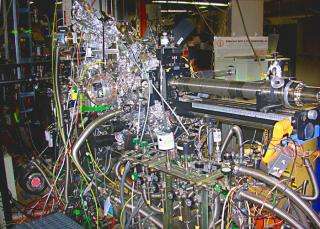
Exactly why these solar cells corrode so quickly is the question researchers at SLAC are now addressing, thanks in part to the efforts of Schiros, a PhD student conducting dissertation research at SSRL. Schiros and colleagues, under the guidance of Stanford Professor Anders Nilsson, are using soft x-rays to look directly into these PEC cells and observe the electrical and chemical reactions occurring at the edge of where water and semiconductor meet. By tracking the corrosion of the semiconductor surfaces on the atomic level, Schiros's work could lead to longer lasting PEC cells.
"We've shown in the lab that we can efficiently produce hydrogen," said Schiros, "but we're a long way from making cells that are stable long enough to meet DOE goals. But by finding the right materials, we will be one step closer to a clean energy infrastructure fueled by a renewable source of hydrogen."
The main obstacle confronting researchers developing PEC cells lies in finding semiconductors that can handle direct exposure to water while converting sunlight to electricity. An unfortunate irony of Nature is that these two properties are largely mutually exclusive—semiconductors stable in water do not efficiently convert sunlight into electricity, and semiconductors that are good solar absorbers corrode easily in water. Scientists have overcome this paradox to some degree by sandwiching various semiconductors with the right properties together. But finding the right combination is tricky.
Despite these obstacles, Schiros and colleagues believe PEC cells hold enormous promise for the efficient production of hydrogen.
"We don't yet know exactly why the reaction dies," said Schiros. "But the photon sciences are well suited to tackle this problem—to understand the fundamental mechanism of photo corrosion."
Source: by Brad Plummer, SLAC Today, Stanford Linear Accelerator Center


