Evolution of a penis worm
Aug 09, 2006
Evolution of a penis worm
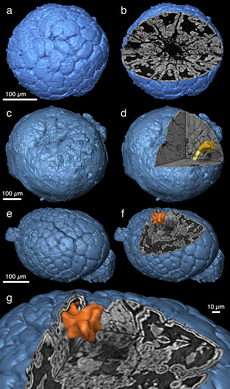
Cleavage-stage embryos from the Lower Cambrian, Southern China, comparing biological detail with non-biological (diagenetic) artefacts.

The detailed images of embryos more than 500 million years old have been revealed by an international team of scientists, led by the University of Bristol. Writing in the journal Nature, Dr Phil Donoghue and colleagues reveal the various developmental stages of fossilised embryos, from the first splitting of cells to pre-hatching, using synchrotron-radiation X-ray tomographic microscopy (SRXTM).

In one instance this has exposed the internal anatomy of the mouth and anus of a close relative of the living penis worm. Another case has revealed a unique pattern for making embryonic worm segments, not seen in any animals living today.

Phil Donoghue, from the University of Bristol, said: “Because of their tiny size and precarious preservation, embryos are the rarest of all fossils. They are just gelatinous balls of cells that rot away within hours. But these fossils are the most precious of all because they contain information about the evolutionary changes that have occurred in embryos over the past 500 million years.”
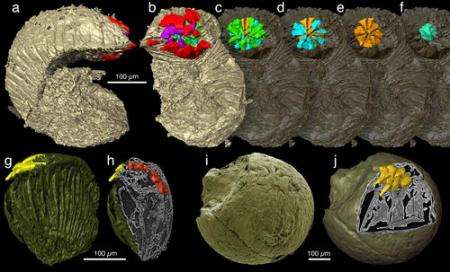
Embryos of the penis worm (Markuelia) from the Cambrian of China and Siberia. a-b two views of the whole embryo, b-f successively lower rings of teeth around the mouth, g-j anus and digestive tract, i-j spines around the anus.

This work has enabled the reinterpretation of previous data on fossilised arthropod embryos, showing that they are similar to those found in modern arthropods (insects and crustaceans). This suggests that arthropod evolutionary history must be pushed further back in time than previously thought.

Using SRXTM at the Swiss Light Source of the Paul Scherrer Institute in Switzerland, the team obtained complete three-dimensional images of the fossilised embryos at sub-micrometre resolution. The scans from these experiments are then manipulated in a computer to reconstruct the internal anatomy of the fossil embryos, unlocking the finest details of their preserved anatomy and revealing their hidden secrets.

The present study demonstrates the feasibility of the method for a variety of questions concerning developmental processes in early fossil animals.

Citation: Synchrotron X-ray tomographic microscopy of fossil embryos. Philip C. J. Donoghue, Stefan Bengtson, Xi-ping Dong, Neil J. Gostling, Therese Huldtgren,
John A. Cunningham, Chongyu Yin, Zhao Yue, Fan Peng & Marco Stampanoni. Nature Vol 442, Issue 7103, pp680-683.

Source: University of Bristol

Explore further: Remote US village abuzz over shipwreck search

add to favorites email to friend print save as pdf

Related Stories

Climate talk shifts from curbing CO2 to adapting

2 hours ago

Efforts to curb global warming have quietly shifted as greenhouse gases inexorably rise. The conversation is no longer solely about how to save the planet by cutting carbon emissions. It's becoming more about ...

Divers begin Lake Michigan search for Griffin ship

3 hours ago

Divers began opening an underwater pit Saturday at a remote site in northern Lake Michigan that they say could be the resting place of the Griffin, a ship commanded by the 17th century French explorer La ...

Paris Air Show peek: Wide-body battle and drones

3 hours ago

The Paris Air Show, which opens for business on Monday Jun. 17, brings hundreds of aircraft to the skies around the French capital, the usual tense competition between aircraft manufacturers Boeing and Airbus, ...

Recommended for you

Divers begin Lake Michigan search for Griffin ship

Jun 16, 2013

Divers began opening an underwater pit Saturday at a remote site in northern Lake Michigan that they say could be the resting place of the Griffin, a ship commanded by the 17th century French explorer La ...

Lost medieval city found in Cambodia

Jun 15, 2013

A lost medieval city that thrived on a mist-shrouded Cambodian mountain 1,200 years ago has been discovered by archaeologists using revolutionary airborne laser technology, a report said.

User comments : 0

More news stories

The hidden agenda of Obama's opposition

Is the US Tea Party movement a racial backlash against President Obama? A new study by Angie Maxwell from the University of Arkansas, and Wayne Parent from Louisiana State University, assesses whether racial attitudes are ...

Origins of 'The Hoff' crab revealed (w/ Video)

The history of a new type of crab, nicknamed 'The Hoff' because of its hairy chest, which lives around hydrothermal vents deep beneath the Southern Ocean and Indian Ocean, has been revealed for the first ...