First Ever World Map of Happiness Produced
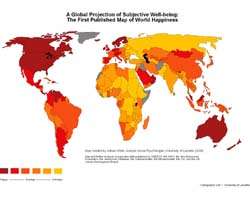
A University of Leicester psychologist has produced the first ever 'world map of happiness.'
Adrian White, an analytic social psychologist at the University’s School of Psychology, analysed data published by UNESCO, the CIA, the New Economics Foundation, the WHO, the Veenhoven Database, the Latinbarometer, the Afrobarometer, and the UNHDR, to create a global projection of subjective well-being: the first world map of happiness.
The projection, which is to be published in a psychology journal this September, will be presented at a conference later in the year. Participants in the various studies were asked questions related to happiness and satisfaction with life. The meta-analysis is based on the findings of over 100 different studies around the world, which questioned 80,000 people worldwide. For this study data has also been analysed in relation to health, wealth and access to education.
Whilst collecting data on subjective well-being is not an exact science, the measures used are very reliable in predicting health and welfare outcomes. It can be argued that whilst these measures are not perfect they are the best we have so far, and these are the measures that politicians are talking of using to measure the relative performance of each country.
The researchers have argued that regular testing as a collaboration between academics in different countries would enable us to track changes in happiness, and what events may cause that. For example what effect would a war, or famine, or national success have on a country's members' happiness. .
Adrian White said: “The concept of happiness, or satisfaction with life, is currently a major area of research in economics and psychology, most closely associated with new developments in positive psychology. It has also become a feature in the current political discourse in the UK.
"There is increasing political interest in using measures of happiness as a national indicator in conjunction with measures of wealth. A recent BBC survey found that 81% of the population think the Government should focus on making us happier rather than wealthier.
“It is worth remembering that the UK is doing relatively well in this area, coming 41st out of 178 nations.
"Further analysis showed that a nation's level of happiness was most closely associated with health levels (correlation of .62), followed by wealth (.52), and then provision of education (.51).
"The three predictor variables of health, wealth and education were also very closely associated with each other, illustrating the interdependence of these factors.
“There is a belief that capitalism leads to unhappy people. However, when people are asked if they are happy with their lives, people in countries with good healthcare, a higher GDP per captia, and access to education were much more likely to report being happy.
“We were surprised to see countries in Asia scoring so low, with China 82nd, Japan 90th and India 125th. These are countries that are thought as having a strong sense of collective identity which other researchers have associated with well-being.
"It is also notable that many of the largest countries in terms of population do quite badly. With China 82nd, India 125th and Russia 167th it is interesting to note that larger populations are not associated with happy countries."
“The frustrations of modern life, and the anxieties of the age, seem to be much less significant compared to the health, financial and educational needs in other parts of the World. The current concern with happiness levels in the UK may well be a case of the 'worried well'."
The 20 happiest nations in the World are:
1 - Denmark
2 - Switzerland
3 - Austria
4 - Iceland
5 - The Bahamas
6 - Finland
7 - Sweden
8 - Bhutan
9 - Brunei
10 - Canada
11 - Ireland
12 - Luxembourg
13 - Costa Rica
14 - Malta
15 - The Netherlands
16 - Antigua and Barbuda
17 - Malaysia
18 - New Zealand
19 - Norway
20 - The Seychelles
Other notable results include:
23 - USA
35 - Germany
41 - UK
62 - France
82 - China
90 - Japan
125 - India
167 - Russia
The three least happy countries were:
176 - Democratic Republic of the Congo
177 - Zimbabwe
178 - Burundi
Source: University of Leicester
