Saturn's faint rings share some of their secrets
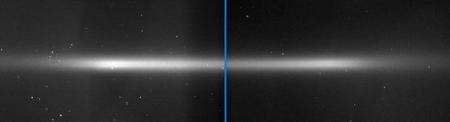
NASA Cassini spacecraft images of Saturn's diaphanous G and E rings are yielding new clues about their structure and formation.
A sequence of recent Cassini images, which has been made into a brief movie, shows an arc of bright material looping around the inside edge of the G ring, a tenuous 7,000-kilometer-wide (4,400 miles) band of dust-sized icy particles lying beyond the F ring by 27,000 kilometers (16,800 miles). Cassini passed between the F and G rings during its insertion into orbit in June 2004.
The G ring arc is the same feature identified in images of this ring taken in May 2005. "We have seen the arc a handful of times over the past year," said Dr. Matt Hedman, Cassini imaging team associate working at Cornell University in Ithaca, New York. "It always appears to be a few times brighter than the rest of the G ring and very tightly confined to a narrow strip along the inside edge of the 'normal' G ring."
Imaging team members now believe this feature is long-lived and may be held together by resonant interactions with the moon Mimas of the type that corral the famed ring arcs around Neptune. "We've known since the days of Voyager that we had Jovian-type and Uranian-type rings within the rings of Saturn," said Cassini imaging team leader Dr. Carolyn Porco in Boulder, Colo., who was the first to work out the dynamics of the Neptunian arcs in Voyager observations. "Now it appears that Saturn may be home to Neptunian-type rings as well. Saturn's rings have it all!"
The researchers do not know exactly how the bright arc formed. One possibility is that a collision between small, perhaps meter-sized icy bodies orbiting within the G ring set loose a cloud of fine particles that eventually came under the influence of Mimas. But this new observation suggests that the remainder of the G ring itself may be derived from particles leaking away from this arc and drifting outwards. Future Cassini imaging observations are being planned to take a closer look at the G ring arc.
Results from Cassini's previous encounters with Enceladus indicated its south polar geysers as the primary source of the E ring particles. Now, images of the E ring with finer resolution than has ever been obtained before show telling details that appear to confirm this relationship.
The new images, taken when Cassini was in the ring plane and consequently showing an edge-on view, reveal a double-banded appearance to the ring, created because the ring is somewhat fainter close to the ring plane than it is 500-1,000 kilometers (300-600 miles) above and below. This appearance can result if the particles comprising the ring circle Saturn on inclined orbits with a very restricted range of inclinations. (A similar effect is seen in the Jupiter's gossamer ring and in the bands of dust found within the Sun's asteroid belt.)
This special condition might arise for two reasons. First, the particles being jetted out of Enceladus and injected into Saturn orbit may begin their journey around Saturn with a very restricted range of velocities and therefore inclinations. Second, the particles may begin with a large range of inclinations but those orbiting very close to the ring plane get gravitationally scattered and removed from that region.
Future studies of the E ring, including observations and dynamical models, should decide this issue. Cassini imaging team member Dr. Joseph Burns, also of Cornell, said, "We'll want images from a few other vantage points to be sure of the structure, and then we can test several models to see why these ring particles end up in such a distinct configuration."
Source: Space Science Institute


