Pluto Could Lose Planet Status
Jun 21, 2006
Pluto Could Lose Planet Status
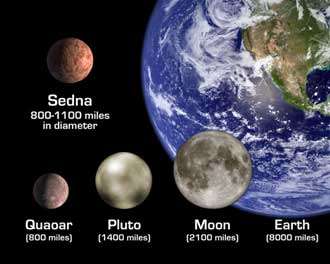
The artist's rendition shows "Sedna" in relation to other bodies in the solar system, including Earth and its Moon; Pluto; and Quaoar, a planetoid beyond Pluto that was the largest known object beyond Pluto. Image courtesy: NASA/JPL-Caltech

At its conference this August, the International Astronomical Union (IAU) will make a decision that could see Pluto lose its status as a planet.

For the first time, the organisation will be officially defining the word "planet", and it is causing much debate in the world of astronomy.

There is only one thing that everyone seems to agree on: there are no longer nine planets in the Solar System.

The debate has been brought to a head by the discovery of a potential 10th planet, temporarily named 2003 UB313 in January 2005. This new candidate planet is bigger than Pluto.

The question now facing the IAU is whether to make this new discovery a planet.

Pluto is an unusual planet as it is made predominantly of ice and is smaller even than the Earth's Moon.

There is a group of astronomers that are arguing for an eight-planet SolarSystem, with neither Pluto or 2003 UB313 making the grade as a planet; but a number of astronomers are arguing for a more specific definition of a planet.

One of these; Kuiper Belt researcher Dr Marc Buie, of the Lowell Observatory in Arizona, has come up with a clear planetary definition he would like to see the IAU adopt.

I believe the definition of planet should be as simple as possible, so I've come up with two criteria," he said.

"One is that it can't be big enough to burn its own matter - that's what a star does. On the small end, I think the boundary between a planet and not a planet should be, is the gravity of the object stronger than the strength of the material of the object? That's a fancy way of saying is it round?"

This definition could lead to our Solar System having as many as 20 planets, including Pluto, 2003 UB313, and many objects that were previously classified as moons or asteroids.

One possible resolution to the debate is for new categories of planet to be introduced. Mercury, Venus, the Earth and Mars would be "rocky planets". The gas-giants Jupiter, Saturn, Uranus and Neptune would be a second category.

Whatever the outcome of this debate there is only one thing that we can be certain of; by September 2006 there will no longer be just nine planets in our Solar System.

Source: BNSC

Explore further: Researchers explain magnetic field misbehavior in solar flares

add to favorites email to friend print save as pdf

Related Stories

Astronomy star gets his due for discovering the Kuiper Belt

Sep 04, 2012

Dressed as usual in jeans and Velcro-secured sneakers, University of California, Los Angeles astronomer David Jewitt sat at his desk recently and feigned concern: What, exactly, does one wear when accepting gold medals from ...

Recent news on the debate over Pluto's planethood

Nov 29, 2010

Earlier this month, Eris -- the distant world first discovered by Caltech's Mike Brown and colleagues back in 2005, paving the way for the eventual demotion of Pluto from planet to dwarf planet -- passed fortuitously ...

Picking Planets from Potatoes

Apr 26, 2010

New research indicates that there may be many more dwarf planets similar to Pluto in our solar system than previously thought. Studying these distant objects can help astrobiologists understand the basic properties ...

Getting WISE About Nemesis

Mar 11, 2010

Is our Sun part of a binary star system? An unseen companion star, nicknamed 'Nemesis,' may be sending comets towards Earth. If Nemesis exists, NASA's new WISE telescope should be able to spot it.

Astronomers Measured Mass of Largest Dwarf Planet

Jun 18, 2007

Aptly named after the Greek goddess of conflict, the icy dwarf planet, Eris, has rattled the general model of our solar system. The object was discovered by astronomer Mike Brown of Caltech in the outer reaches ...

Recommended for you

Very Large Telescope celebrates 15 years of success

3 hours ago

(Phys.org) —With this new view of a spectacular stellar nursery ESO is celebrating 15 years of the Very Large Telescope—the world's most advanced optical instrument. This picture reveals thick clumps ...

Fragile mega-galaxy is missing link in history of cosmos

20 hours ago

Two hungry young galaxies that collided 11 billion years ago are rapidly forming a massive galaxy about 10 times the size of the Milky Way, according to UC Irvine-led research published Wednesday in the journal ...

User comments : 0

More news stories

Bacterium from Canadian High Arctic and life on Mars

(Phys.org) —The temperature in the permafrost on Ellesmere Island in the Canadian high Arctic is nearly as cold as that of the surface of Mars. So the recent discovery by a McGill University led team of ...

Researchers forward quest for quantum computing

Research teams from UW-Milwaukee and the University of York investigating the properties of ultra-thin films of new materials are helping bring quantum computing one step closer to reality.

Cold plasma successful against brain cancer cells

For the first time, physicists from the Max Planck Institute for Extraterrestrial Physics (MPE), biologists and physicians demonstrated the synergistic effect of cold atmospheric plasma - a partly ionized ...

Chemists find new compounds to curb staph infection

(Phys.org) —In an age when microbial pathogens are growing increasingly resistant to the conventional antibiotics used to tamp down infection, a team of Wisconsin scientists has synthesized a potent new ...