Korea Joins International Computing Infrastructure
The Global Ring Network for Advanced Applications Development (GLORIAD) reached a milestone in its vision to create a network of high-speed computing capability around the northern hemisphere when it celebrated connectivity with Korea in a ceremony last month.
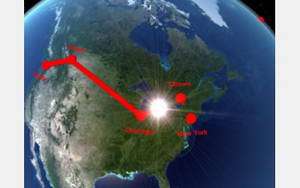
Image: This image shows the participants in GLORIAD's high-speed computing network. Credit: Trent Schindler, National Science Foundation
Facilitated by the Korea Institute for Science and Technology Information (KISTI), two new 10-gigabit-per-second (10G) circuits between Korea-North America and Korea-China add significant new capacity to the existing base of global research and education network connectivity.
U.S. GLORIAD project director, Greg Cole, said, "The ceremony in Seoul celebrated much more than circuits. This new infrastructure points the way toward the future of research and engineering networking and will undoubtedly advance the globalization of science."
The GLORIAD network--a highly cooperative effort--includes Canada, China, Korea, the Netherlands, Russia and the United States. The advanced network infrastructure provided by GLORIAD promotes secure dialog and research activities between science and engineering communities in countries that form new and different geopolitical partnerships.
The diplomatic efforts of GLORIAD participants have resulted in a human networking infrastructure whose presence centers on an effective global cyberinfrastructure made available to its scientific users. "The spirit of openness needed to establish such an advanced global service will be of tremendous benefit to underserved regions and populations of Central and Southeast Asia and Eastern Europe," said Natasha Bulashova, co-principal investigator of the U.S. GLORIAD effort.
In the United States, the project provides resources for research conducted at universities, the Department of Energy, NASA, National Institutes of Health, National Oceanic and Atmospheric Administration and the U. S. Geological Survey.
Among the many international science collaborations enabled by these new connections is Korea's Molecular Simulation Grid (MGrid), a component of the National Science Foundation's (NSF) Pacific Rim Applications and Grid Middleware Assembly project (PRAGMA), which uses GLORIAD's network infrastructure to create an open "problem-solving environment" for molecular analyses of protein structures. MGrid, coupled with GLORIAD, fosters collaborative research and enables calculations that require enormous computational power and months of compute time--even on supercomputers.
GLORIAD allows for the transfer of incredible amounts of data. In the United States for example, residential cable technology can theoretically support the transfer of approximately 30-megabits per second (Mbps). That's 30 million bits--or 30 million "0s" and "1s" of computer data--sent per second. However, actual performance may be closer to 3 Mbps because of many factors, such as service glitches, spyware, routers and old computers. GLORIAD's 10G network transfers 10 billion bits per second, over 1,000 times more data than the average home cable connection. Said another way, GLORIAD users can send the amount of data contained in a pickup truck full of paper between Korea and North America every second.
GLORIAD also maintains a strong partnership with the telecommunications provider, VSNL International, for high-speed trans-Atlantic and trans-Pacific links. VSNL envisions continued collaboration with GLORIAD and is currently implementing additional capacity for the team.
Science organizations and agencies in each of the partner countries provide substantial funding for their respective components. A total of five awards including GLORIAD are funded by NSF's International Research Network Connections (IRNC) program. Links and services funded by the IRNC program connect U.S. research networks with peer networks in other parts of the world. NSF currently supports the U.S. GLORIAD management team, based at the Joint Institute for Computational Science of the University of Tennessee and Oak Ridge National Laboratory, until 2009. The Korean Ministry of Science and Technology (MOST) funds the new Korea-North America and Korea-China circuits.
GLORIAD originated as a U.S.-Russia science Internet-based project called NaukaNet, which was funded by the NSF and the Russian Ministry of Science from 1998 to 2004. "Little GLORIAD," an initial networking endeavor between the United States, Russia and China, was formally launched in Jan. 2004.
Source: NSF


