Smashing young stars leave dwarfs in their wake
Jun 09, 2006
Smashing young stars leave dwarfs in their wake
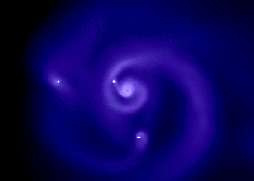
Visualizations of brown dwarf simulations completed by Sijing Shen for her Master's Thesis (May 2006) under the supervision of James Wadsley.

Astronomers have discovered that the large disks of gas and dust around young stars will fragment if two young stars pass close to each other and form smaller brown dwarfs stars with disks of their own.

The news was announced this week at the Canadian Astronomical Society in Calgary, Alta, by James Wadsley, assistant professor of Physics & Astronomy at McMaster University, and his student Sijing Shen.

"This is an exciting discovery because it may be the dominant way brown dwarfs are made," says Wadsley. "The challenge to theorists was to explain not only the origin of brown dwarfs but also the details telescopes are seeing: brown dwarfs with disks and the systems of many dwarfs orbiting a single regular star. We've done that."

Brown dwarf stars are as common in number as large stars but are no more than 8 percent of the mass of the Sun. Their low mass prevents nuclear fusion in their core so they don't shine like regular stars. Regular stars form from cold dense cores in giant molecular gas clouds. The natural mass of a core is expected to be large, closer to that of a regular star than a brown dwarf so something extra was required to understand the origin of brown dwarfs.

Using SHARCNET (Shared Hierarchical Academic Research Computing Network) parallel computing facilities at McMaster, Shen and Wadsley simulated several encounters between young stars with disks at unprecedented resolution, seeing gas pile-ups, drawn-out tidal arms and huge masses of gas driven closer to the stars. Amid this chaos several small objects were seen to form, from Jupiter-sized objects up to brown dwarfs. Reports from lower resolution simulations by other groups had shown no indication of disks. However, in every case, the new objects had disks with sizes ranging up to 18 astronomical units (the size of Saturn's orbit). As these rapidly spinning disks evolve they should produce jets of gas and even result in the formation of planets orbiting the brown dwarfs. Both these things have been observed in nature.

"We had no idea the simulated results would be so beautiful and complex, and then we found out that observations were revealing brown dwarfs with disks that matched what we were seeing, " said Shen, who is studying for her PhD in Physics & Astronomy at McMaster.

The simulated objects would either leave the stars on their own or in groups, or remain as multiple brown dwarf companions to a star. Telescopes have detected up to three brown dwarfs orbiting a regular star. Thus the brown dwarfs and planets in the simulations are remarkably similar to what is observed. However, it remains to be determined exactly how often such encounters occur in nature and what fraction of those encounters reliably produce brown dwarfs. For this, Shen and Wadsley are planning a much larger set of encounter simulations using SHARCNET's new supercomputers.

Source: McMaster University

Explore further: Three centaurs follow Uranus through the solar system

add to favorites email to friend print save as pdf

Related Stories

Snowden's life surrounded by spycraft

13 hours ago

In the suburbs edged by woods midway between Baltimore and the U.S. capital, residents long joked that the government spy shop next door was so ultra-secretive its initials stood for "No Such Agency." But ...

Winners and losers at this week's E3

14 hours ago

Since the first battles over "Pong" machines in local arcades four decades ago, video gamers have loved good competition. And this year's Electronic Entertainment Expo—the industry's largest annual gathering—presented ...

Europe's space truck docks with ISS

14 hours ago

A robot freighter bearing 6.6 tonnes of cargo docked with the International Space Station (ISS) on Saturday, the European Space Agency (ESA) said.

Secret to Prism program: Even bigger data seizure

14 hours ago

In the months and early years after the Sept. 11, 2001, terrorist attacks, FBI agents began showing up at Microsoft Corp. more frequently than before, armed with court orders demanding information on customers.

Recommended for you

Three centaurs follow Uranus through the solar system

Jun 18, 2013

Astrophysicists from the Complutense University of Madrid have confirmed that Crantor, a large asteroid with a diameter of 70 km has an orbit similar to that of Uranus and takes the same amount of time to ...

Final curtain for Europe's deep-space telescope

Jun 17, 2013

The deep-space telescope Herschel took its final bow on Monday, climaxing a successful four-year mission to observe the birth of stars and galaxies, the European Space Agency (ESA) said.

Hubble spots a very bright contortionist

Jun 17, 2013

(Phys.org) —The contorted object captured by Hubble in this picture is IRAS 22491-1808, also known as the South America Galaxy. It is an ultra-luminous infrared galaxy (ULIRG) that emits a huge amount of ...

Study explains decades of black hole observations

Jun 14, 2013

(Phys.org) —A new study by astronomers at NASA, Johns Hopkins University and Rochester Institute of Technology confirms long-held suspicions about how stellar-mass black holes produce their highest-energy ...

User comments : 0

More news stories

Looking at sachet water consumption in Ghana

Many of West Africa's largest cities continue to lag in their provision of piped water to residents. Filling the service gap are plastic water sachets, which have become an important source of drinking water ...

Metamorphosis of moon's water ice explained

Using data gathered by NASA's Lunar Reconnaissance Orbiter (LRO) mission, scientists believe they have solved a mystery from one of the solar system's coldest regions—a permanently shadowed crater on the ...

LA to give every student an iPad; $30M order

Los Angeles' school system, the second largest in the United States, is ordering iPads for all its students, handing Apple a major success in its quest to make the tablet computer a replacement for textbooks.