June 2, 2006 feature
Scientists design Maglev car with greater stability
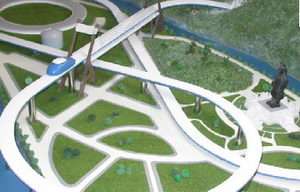
Since the late ‘60s, scientists have been designing, building and operating “flying trains,” or magnetically levitated (“Maglev”) systems. However, the sci-fi-like technology still faces challenges for increased stability, controllability and cost-effectiveness – but scientists are making steady improvements.
Maglev trains, which use the electromagnetic force to overcome gravity, have intrigued scientists for the past several decades. Levitating several centimeters above the track, the train cars have no physical contact and no friction with the track, enabling speeds of more than 400 mph. Implementing Maglevs into urban areas – or even across the country – could make a five-hour drive a smooth 40-minute ride, as well as reinvent the world’s infrastructure.
The first operating low-speed Maglev systems, built in England and Germany in the mid-‘80s, are no longer in existence. However, the newest 300-mph system built in 2002 in Shanghai, China has revived political and consumer interest in the technology, despite current large construction costs. Although the city plans to extend the 18-mile track to 100 miles for the World Expo in 2010, the technology must become more economically viable with proven safety for mainstream adoption.
As part of the investigation, a team of scientists (W. Yang et al.) from China has recently designed and built a new model for a Maglev car that could offer significant stability advantages over current technology. The scientists used specially fabricated high temperature superconductors (HTSC) for the cars and permanent magnets for the tracks, which demonstrate a higher levitation force and greater stability than when permanent magnets are used on both the track and car. Although the car models are only about 12 cm long and 4 cm wide, they demonstrated frictionless, stable movement across the 10-meter-long track.
“The arrangement of the magnets made it easy to get a uniform magnetic field distribution along the length of the track,” wrote W. Yang et al. in a recent issue of Superconductor Science and Technology. “The model can be used [for] a fast transportation system to students and adults.”
In the HTSC model, the cars are propelled by a combination of linear motors on the tracks and aluminum rotors on the cars. Photoelectric switches near the linear motors save energy by ensuring that the motors work only when the car is traveling through them.
The HTSC model’s large magnetic fields across the track also provide a strong guidance force and good magnetic distribution that prohibits the cars from escaping the track. Because this magnetic configuration provides a large dragging force, it also eliminates the need for any exterior stability control.
Using liquid nitrogen to cool the HTSCs to -196 degrees C, the scientists investigated different cooling methods to optimize the levitation and guidance forces. The team found that a field cooled process, which cools the magnets inside the car after the car is on the track, provides significant stability, but also requires further investigation.
Citation: Yang, W. M., et al. A small Maglev car model using YBCO bulk superconductors. Superconductor Science and Technology. 19 (2006) S537-S539.
By Lisa Zyga, Copyright 2006 PhysOrg.com. All rights reserved. This material may not be published, broadcast, rewritten or redistributed.


