ESA's SOHO will lead a fleet of solar observatories
May 24, 2006
ESA's SOHO will lead a fleet of solar observatories
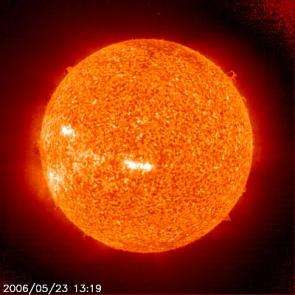
This image of the Sun was taken by SOHO's EIT (Extreme ultraviolet Imaging Telescope) instrument on 23 May 2006. EIT can take images of the solar atmosphere at several wavelengths, and therefore it is able to show solar material at different temperatures. In the images taken at 304 Angstroms the bright material is at 60 000 to 80 000 ºC. In those taken at 171, at one million degrees; 195 Angstrom images correspond to about 1.5 million ºC; 284 Angstrom, to 2 million degrees. The hotter the temperature, the higher you look in the solar atmosphere. Credits: ESA, NASA, SOHO/EIT team

New funding, to extend the mission of ESA's venerable solar watchdog SOHO, will ensure it plays a leading part in the fleet of solar spacecraft scheduled to be launched over the next few years.

Since its launch on 2 December 1995, The Solar and Heliospheric Observatory (SOHO) has provided an unprecedented view of the Sun – and not just the side facing the Earth. Two teams have now developed techniques for using SOHO to recreate the conditions on the far side of the Sun. The new funding will allow its mission to be extended from April 2007 to December 2009. Despite being over ten years old now, SOHO just keeps on working, monitoring the activity on the Sun and allowing scientists to see inside the Sun by recording the seismic waves that ripple across the surface of our nearest star.

More than 2300 scientists have used data from the solar observatory to forward their research, publishing over 2400 scientific papers in peer-reviewed journals. During the last two years, at least one SOHO paper has been accepted for publication every working day.

"This mission extension will allow SOHO to cement its position as the most important spacecraft in the history of solar physics," says Bernhard Fleck, SOHO's project scientist, "There is a lot of valuable work for this spacecraft still to do."

During the next two years, five new solar spacecraft will join SOHO in orbit. ESA is involved in two of these spacecraft. The Japan Aerospace Exploration Agency (ISAS/JAXA) has built Solar B and will launch it later this year. ESA will supply the use of a ground station at Svalbard, Norway in exchange for access to the data.

Next year, ESA will launch Proba-2, a technology demonstration satellite that carries solar instruments. In particular, it will carry a complementary instrument to SOHO's EIT camera. Whilst EIT concentrates on the origin and early development of solar eruptions, Proba-2's camera will be able to track them into space.

NASA plans to launch the STEREO pair of spacecraft later this year, and the Solar Dynamics Orbiter in 2008. Far from making SOHO obsolete, these newer solar satellites embrace it as a crucial member of the team. SOHO will provide a critical third point of view to assist the analysis of STEREO's observations. Also, SOHO's coronagraph will remain unique. The instrument is capable of blotting out the glare from the Sun so that the tenuous outer atmosphere of the Sun is visible for study.

"By next year, we will have a fleet of spacecraft studying the Sun," says Hermann Opgenoorth, Head of Solar System Missions Division at ESA. This will advance the International Living With a Star programme (ILWS), an international collaboration of scientists dedicated to a long-term study of the Sun and its effects on Earth and the other solar system planets.

ILWS will possibly culminate in the launch of the advanced ESA satellite, Solar Orbiter, around 2015. It is designed to travel close to the Sun, to gain a close-up look at the powerful processes at the heart of our Solar System.

Source: European Space Agency

Explore further: NASA builds unusual testbed for analyzing X-ray navigation technologies

add to favorites email to friend print save as pdf

Related Stories

Comet Lemmon, Now in STEREO

Apr 25, 2013

An icy interloper was in the sights of a NASA spacecraft this past weekend. Comet 2012 F6 Lemmon passed through the field of view of NASA's HI2A camera as seen from its solar observing STEREO Ahead spacecraft. ...

Scientists 'see' flux rope formation for the first time

Apr 03, 2013

(Phys.org) —Naval Research Laboratory scientists have observed, for the very first time, the formation of solar flux ropes, which are a type of solar magnetic field. Models of flux ropes have been drawn ...

Sun has "eureka!" moment

Aug 27, 2012

(Phys.org)—At the onset of a series of coronal mass ejections (CMEs) on August 20, 2012, this bulbous CME certainly resembled a light bulb. It has the thin outer edge and a bright, glowing core at its center. ...

Did a comet hit cause an explosion on the sun?

Oct 05, 2011

This amazing video from the SOHO mission (Solar and Heliospheric Observatory) shows a sun-diving comet hitting the solar surface on October 1, 2011 and unexpectedly a huge explosion occurs shortly after. Are the two events ...

Sun's constant size surprises scientists

May 13, 2010

(PhysOrg.com) -- A group of astronomers led by the University of Hawaii's Dr. Jeff Kuhn has found that in recent times the sun's size has been remarkably constant. Its diameter has changed by less than one ...

Recommended for you

Galaxy's Ring of Fire

May 18, 2013

Johnny Cash may have preferred this galaxy's burning ring of fire to the one he sang about falling into in his popular song. The "starburst ring" seen at center in red and yellow hues is not the product of ...

User comments : 0

More news stories

Volcanoes cause climate gas concentrations to vary

Trace gases and aerosols are major factors influencing the climate. With the help of highly complex installations, such as MIPAS on board of the ENVISAT satellite, researchers try to better understand the ...

NASA's IRIS mission readies for a new challenge

(Phys.org) —The time draws near. NASA is getting ready to launch a new mission, a mission to observe a largely unexplored region of the solar atmosphere that powers its dynamic million-degree outer atmosphere and drives ...

Costs to treat stroke in America may double by 2030

Costs to treat stroke are projected to more than double and the number of people having strokes may increase 20 percent by 2030, according to the American Heart Association/American Stroke Association.