Researchers Assess Risks Associated with Living in Low-Lying Coastal Areas
May 17, 2006

Researchers Assess Risks Associated with Living in Low-Lying Coastal Areas

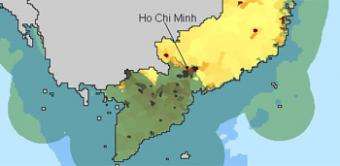
Many large urban areas in developing and developed countries alike are at risk of flooding from storm surges. Ho Chi Minh City, with a population of more than 6 million, many of whom live within 100km of the coast and at less than 10m elevation, is one of two major urban centers in Vietnam partly within the low-elevation coastal zone.

For many, sea-level rise is a remote and distant threat faced by people like the residents of the Tuvalu Islands in the South Pacific, where the highest point of land is only 5 meters (15 feet) above sea level and tidal floods occasionally cover their crops in seawater.

Now, however, a recently published study by researchers from The Earth Institute at Columbia University and the International Institute for Environment and Development suggests that as much as 10 percent of the world's population is vulnerable. In particular, the authors have found that many large cities face risks posed by rising sea level and increased storm intensity.

"Urban areas have traditionally been studied in a way that separates them from their physical surroundings," says Deborah Balk, a demographer with the Center for International Earth Science Information Network (CIESIN), a member of The Earth Institute at Columbia University. "We talk about urban issues as if they occur in a spatial vacuum, but you can't address these questions without understanding the spatial dimensions."

One often-overlooked dimension is elevation. Ten percent of the world's population lives in coastal areas that are less than 10 meters (33 feet) above sea level, reports Balk and her colleagues. Although they only comprise about 2.2 percent of the world's land area, these low-elevation coastal zones (LECZs) are home to 600 million people. In addition, about 360 million people in LECZs live in urban areas which means that more people will be exposed to hazards such as sea-level rise and storm surges—phenomena that are expected to worsen as a result of global warming.

The study reports that low-income countries and the Least Developed Countries, a designation used by the Intergovernmental Panel on Climate Change to identify 50 very-low-income nations, in LECZs have a particularly high risk. In particular, Vietnam and Bangladesh have both a high percentage of their total area as well as major metropolitan areas situated inside the LECZ.

Wealthier countries also face significant risks, the researchers say, but have more resources with which to deal with climate variability. However, even with access to economic and technical resources, the challenge of preparing for sea level rise and increases in coastal storms remains difficult for high-income countries. More than 60 percent of the population and land area of The Netherlands, for example is located in the LECZ, and the country has expended vast resources over decades on flood prevention projects. Despite this, they have achieved only mixed results and some efforts been abandoned as ineffective or not cost-effective.

Looking forward, urban areas in low-lying coastal areas may indicate those countries where direct impacts on humans will be especially high in the future. The U.S., in particular, faces significant risk with more urban areas in the LECZ than any other country.

No one geographic or economic indicator can predict risk, the researchers conclude, adding that the different types of cities and coastal zones must be examined in more detail in order to assess the vulnerabilities to climate change faced by different countries: "These results illustrate the importance of looking beyond the small island states to recognize how wide-spread the risks truly are."

Source: The Earth Institute at Columbia University

3.3 /5 (4 votes)  

Rank 3.3 /5 (4 votes)
Tags

Relevant PhysicsForums posts

More news stories

Yale study concludes public apathy over climate change unrelated to science literacy

Are members of the public divided about climate change because they don't understand the science behind it? If Americans knew more basic science and were more proficient in technical reasoning, would public consensus match ...

Space & Earth / Environment

created 11 hours ago | popularity 4.8 / 5 (6) | comments 27 | with audio podcast

Land and sea species differ in climate change response: study

(Phys.org) -- Marine and terrestrial species will likely differ in their responses to climate warming, new research by Simon Fraser University and Australia’s University of Tasmania has found.

Space & Earth / Environment

created 9 hours ago | popularity 4 / 5 (5) | comments 6 | with audio podcast

10 million years needed to recover from mass extinction

It took some 10 million years for Earth to recover from the greatest mass extinction of all time, latest research has revealed.

Space & Earth / Earth Sciences

created 11 hours ago | popularity 4.2 / 5 (5) | comments 2 | with audio podcast

Sophisticated simulations predict future warming

The chances of our planet being hit by a global warming of 3 degrees Celsius by 2050 is as likely as it being hit by an increase of 1.4 degrees, new research shows. Presented in the journal Nature Geoscience, the British study ...

Space & Earth / Earth Sciences

created May 22, 2012 | popularity 3.8 / 5 (11) | comments 51

Kyoto Protocol architect 'frustrated' by climate dialogue

UN climate talks are going nowhere, as politicians dither or bicker while the pace of warming dangerously speeds up, one of the architects of the Kyoto Protocol told AFP.

Space & Earth / Environment

created May 23, 2012 | popularity 3.4 / 5 (8) | comments 43


Stunning image of smallest possible five-ringed structure

Scientists have created and imaged the smallest possible five-ringed structure – about 100,000 times thinner than a human hair – and you'll probably recognise its shape.

'Unzipped' carbon nanotubes could help energize fuel cells, batteries

Multi-walled carbon nanotubes riddled with defects and impurities on the outside could replace some of the expensive platinum catalysts used in fuel cells and metal-air batteries, according to scientists at ...

Change in developmental timing was crucial in the evolutionary shift from dinosaurs to birds: study

At first glance, it's hard to see how a common house sparrow and a Tyrannosaurus Rex might have anything in common. After all, one is a bird that weighs less than an ounce, and the other is a dinosaur that ...

Computer model used to pinpoint prime materials for efficient carbon capture

When power plants begin capturing their carbon emissions to reduce greenhouse gases – and to most in the electric power industry, it's a question of when, not if – it will be an expensive undertaking.

T cells 'hunt' parasites like animal predators seek prey, study shows

By pairing an intimate knowledge of immune-system function with a deep understanding of statistical physics, a cross-disciplinary team at the University of Pennsylvania has arrived at a surprising finding: T cells use a movement ...

Browser wars flare in mobile space

The browser wars are heating up again, but this time the fight is for dominance of the mobile Internet.