Researchers Look Beyond the Birth of the Universe
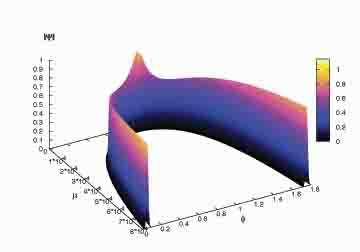
According to Einstein’s general theory of relativity, the Big Bang represents The Beginning, the grand event at which not only matter but space-time itself was born. While classical theories offer no clues about existence before that moment, a research team at Penn State has used quantum gravitational calculations to find threads that lead to an earlier time.
“General relativity can be used to describe the universe back to a point at which matter becomes so dense that its equations don’t hold up,” says Abhay Ashtekar, Holder of the Eberly Family Chair in Physics and Director of the Institute for Gravitational Physics and Geometry at Penn State. “Beyond that point, we needed to apply quantum tools that were not available to Einstein.” By combining quantum physics with general relativity, Ashtekar and two of his post-doctoral researchers, Tomasz Pawlowski and Parmpreet Singh, were able to develop a model that traces through the Big Bang to a shrinking universe that exhibits physics similar to ours.
In research reported in the current issue of Physical Review Letters, the team shows that, prior to the Big Bang, there was a contracting universe with space-time geometry that otherwise is similar to that of our current expanding universe. As gravitational forces pulled this previous universe inward, it reached a point at which the quantum properties of space-time cause gravity to become repulsive, rather than attractive.
“Using quantum modifications of Einstein’s cosmological equations, we have shown that in place of a classical Big Bang there is in fact a quantum Bounce,” says Ashtekar. “We were so surprised by the finding that there is another classical, pre-Big Bang universe that we repeated the simulations with different parameter values over several months, but we found that the Big Bounce scenario is robust.”
While the general idea of another universe existing prior to the Big Bang has been proposed before, this is the first mathematical description that systematically establishes its existence and deduces properties of space-time geometry in that universe.
The research team used loop quantum gravity, a leading approach to the problem of the unification of general relativity with quantum physics, which also was pioneered at the Penn State Institute of Gravitational Physics and Geometry. In this theory, space-time geometry itself has a discrete 'atomic' structure and the familiar continuum is only an approximation. The fabric of space is literally woven by one-dimensional quantum threads. Near the Big-Bang, this fabric is violently torn and the quantum nature of geometry becomes important. It makes gravity strongly repulsive, giving rise to the Big Bounce.
"Our initial work assumes a homogenous model of our universe," says Ashtekar. "However, it has given us confidence in the underlying ideas of loop quantum gravity. We will continue to refine the model to better portray the universe as we know it and to better understand the features of quantum gravity."
Source: Penn State
