Solar Cycle 25 peaking around 2022 could be one of the weakest in centuries
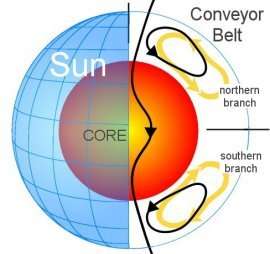
The Sun's Great Conveyor Belt has slowed to a record-low crawl, according to research by NASA solar physicist David Hathaway. "It's off the bottom of the charts," he says. "This has important repercussions for future solar activity."
The Great Conveyor Belt is a massive circulating current of fire (hot plasma) within the Sun. It has two branches, north and south, each taking about 40 years to perform one complete circuit. Researchers believe the turning of the belt controls the sunspot cycle, and that's why the slowdown is important.
"Normally, the conveyor belt moves about 1 meter per second—walking pace," says Hathaway. "That's how it has been since the late 19th century." In recent years, however, the belt has decelerated to 0.75 m/s in the north and 0.35 m/s in the south. "We've never seen speeds so low."
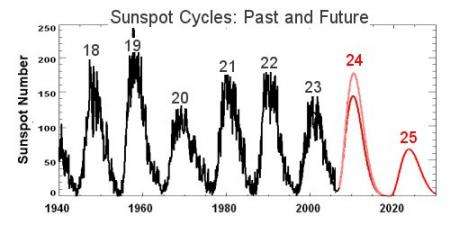
According to theory and observation, the speed of the belt foretells the intensity of sunspot activity ~20 years in the future. A slow belt means lower solar activity; a fast belt means stronger activity.
"The slowdown we see now means that Solar Cycle 25, peaking around the year 2022, could be one of the weakest in centuries," says Hathaway.
This is interesting news for astronauts. Solar Cycle 25 is when the Vision for Space Exploration should be in full flower, with men and women back on the Moon preparing to go to Mars. A weak solar cycle means they won't have to worry so much about solar flares and radiation storms.
On the other hand, they will have to worry more about cosmic rays. Cosmic rays are high-energy particles from deep space; they penetrate metal, plastic, flesh and bone. Astronauts exposed to cosmic rays develop an increased risk of cancer, cataracts and other maladies. Ironically, solar explosions, which produce their own deadly radiation, sweep away the even deadlier cosmic rays. As flares subside, cosmic rays intensify—yin, yang.
Hathaway's prediction should not be confused with another recent forecast: A team led by physicist Mausumi Dikpata of NCAR has predicted that Cycle 24, peaking in 2011 or 2012, will be intense. Hathaway agrees: "Cycle 24 will be strong. Cycle 25 will be weak. Both of these predictions are based on the observed behavior of the conveyor belt."
How do you observe a belt that plunges 200,000 km below the surface of the sun?
"We do it using sunspots," Hathaway explains. Sunspots are magnetic knots that bubble up from the base of the conveyor belt, eventually popping through the surface of the sun. Astronomers have long known that sunspots have a tendency to drift—from mid solar latitudes toward the sun's equator. According to current thinking, this drift is caused by the motion of the conveyor belt. "By measuring the drift of sunspot groups," says Hathaway, "we indirectly measure the speed of the belt."
Using historical sunspot records, Hathaway has succeeded in clocking the conveyor belt as far back as 1890. The numbers are compelling: For more than a century, "the speed of the belt has been a good predictor of future solar activity."
If the trend holds, Solar Cycle 25 in 2022 could be, like the belt itself, "off the bottom of the charts."
Source: Science@NASA, by Dr. Tony Phillips


