Meteorites discovered to carry interstellar carbon
Like an interplanetary spaceship carrying passengers, meteorites have long been suspected of ferrying relatively young ingredients of life to our planet.
Using new techniques, scientists at the Carnegie Institution’s Department of Terrestrial Magnetism have discovered that meteorites can carry other, much older passengers as well—primitive, organic particles that originated billions of years ago either in interstellar space, or in the outer reaches of the solar system as it was beginning to coalesce from gas and dust.
The study shows that the parent bodies of meteorites—the large objects from the asteroid belt—contain primitive organic matter similar to that found in interplanetary dust particles that might come from comets. The finding provides clues about how organic matter was distributed and processed in the solar system during this long-gone era. The work is published in the May 5, 2006, issue of Science.
“Atoms of different elements come in different forms, or isotopes, and the relative proportions of these depend on the environmental conditions in which their carriers formed, such as the heat encountered, chemical reactions with other elements, and so forth,” explained lead author Henner Busemann. “In this study we looked at the relative amounts of different isotopes of hydrogen (H) and nitrogen (N) associated with tiny particles of insoluble organic matter to determine the processes that produced the most pristine type of meteorites known. The insoluble material is very hard to break down chemically and survives even very harsh acid treatments.”
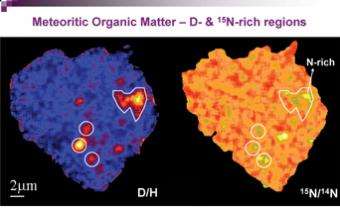
The researchers used a microscopic imaging technique to analyze the isotopic composition of insoluble organic matter from six carbonaceous chondrite meteorites—the oldest type known. The relative proportion of isotopes of nitrogen and hydrogen associated with the insoluble organic matter act as “fingerprints” and can reveal how and when the carbon was formed. The isotope of nitrogen that is most often found in nature is 14N; its heavier sibling is 15N. Differing amounts of 15N, in addition to a heavier form of hydrogen called deuterium, (D), allow researchers to tell if a particle is relatively unaltered from the time when the solar system was first forming.
“The tell-tale signs are lots of deuterium and 15N chemically bonded to carbon,” commented co-author Larry Nittler. “We have known for some time, for instance, that interplanetary dust particles (IDP), collected from high-flying airplanes in the upper atmosphere, contain huge excesses of these isotopes, probably indicating vestiges of organic material that formed in the interstellar medium. The IDPs have other characteristics indicating that they originated on bodies—perhaps comets—that have undergone less severe processing than the asteroids from which meteorites originate.”
The scientists found that some meteorite samples, when examined at the same tiny scales as interplanetary dust particles, actually have similar or even higher abundances of 15N and D than those reported for IDPs. “It’s amazing that pristine organic molecules associated with these isotopes were able to survive the harsh and tumultuous conditions present in the inner solar system when the meteorites that contain them came together,” reflected co-author Conel Alexander. “It means that the parent bodies—the comets and asteroids—of these seemingly different types of extraterrestrial material are more similar in origin than previously believed.”
“Before, we could only explore minute samples from IDPs. Our discovery now allows us to extract large amounts of this material from meteorites, which are large and contain several percent of carbon, instead of from IDPs, which are on the order of a million million times less massive. This advancement has opened up an entirely new window on studying this elusive period of time,” concluded Busemann.
Source: Carnegie Institution


