
Credit: Energy Environ. Sci., 2014, Advance Article, DOI: 10.1039/C4EE01776E
(Phys.org) —A team of researchers at South Korea's Daegu Gyeongbuk Institute of Science and Technology has created an elastic-mechanoluminescent material that emits light when exposed to wind. At high wind speeds, the material has been shown able to emit light equivalent to a computer screen.
People have known about mechanoluminescence, for hundreds, if not thousands of years. It's where a material emits light when forced to endure mechanical stress—breath mints are one example. Other than as a novelty, such luminescence hasn't had much use, however—not only does its use mean the destruction of the material, but the light emitted is generally too faint to be of much use. The materials also tend to emit green or yellow light which most people don't like looking at for very long.
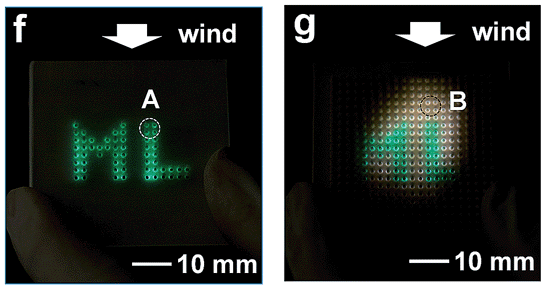
One way to make such materials more useful is to make them elastic, which is what the team in Korea has done. They mixed colored phosphors made out of copper-doped zinc sulfide and embedded the results in a plastic composite. The result was an elasto-mechanoluminescent material that emits white light that is brighter than other mechanoluminescent materials. The team found that the color of the light could be fine-tuned by altering the proportion of the phosphors used in the original mix. The elastic plastic material was shaped into tube-like structures that were mounted on a base. As wind blows across the tubes, they bend like grass or trees and light up. Taking the idea further, the team mounted several of the tube on a clear base arranged as letters—when artificial wind was introduced, the letters lit up the base like a sign.
The material created by the team is still limited in one major way, it takes a lot of wind to get it to emit a reasonable amount of light—approximately 40m/s, which is comparable to a category 2 hurricane. There is also the problem of lack of luminescence when there is no wind blowing. Undaunted, the team believes they can improve their material to get it to respond to something closer to a gentle breeze, which should make it useful for outdoor applications such as street lighting.
Written for you by our author Bob Yirka—this article is the result of careful human work. We rely on readers like you to keep independent science journalism alive. If this reporting matters to you, please consider a donation (especially monthly). You'll get an ad-free account as a thank-you.
© 2014 Phys.org
