April 26, 2012 report
New research suggests initial mass function for galaxies not universal

Bob Yirka
Author
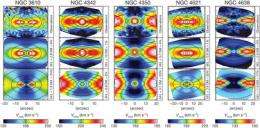
(Phys.org) -- Over the past several years there has been debate in the astrophysics community regarding the distribution of stars in galaxies, specifically their mass range. Astronomers use an initial mass function (IMF) to calculate the numbers of different kinds of stars in any given galaxy, but what’s not been clear is whether the IMF applies to all galaxies of all types. Now, a large international group of astronomers has found after studying data form 260 galaxies that the distribution of stars in early galaxies appears to be different from the distribution of stars in galaxies that formed later in time, casting doubt on the dependability of the IMF. They report their findings in their paper published in the journal Nature.
Because some stars are too small to be studied individually, astronomers have come up with a way to measure the number of stars of different types in a galaxy by measuring the spectrum for the entire galaxy and then applying an initial mass function to it. Doing so gives a good approximation of the number of stars in any given mass range. The problem up till now however, is that it’s not been clear if the same IMF applies to all types of galaxies (spiral, elliptical or irregular). To find out, the researchers turned to the ATLAS3D project (a multi-wavelength survey of 260 so-called early type, i.e. elliptical galaxies) to help them generate a two dimensional distribution of stars in galaxies along with their statistical spectrums.
Using the data they’d extracted, the team built several models (varying the dark matter composition) to generate galaxy structures. In so doing, they found that the ratio of mass to light from just the stars in their models (minus gas and dark matter) for some elliptical low mass galaxies did indeed look like spiral galaxies. But they also found some that did not, which means that the IMF is not universal. They also found generally the same results no matter which dark matter composition they used, which means of course that the results obtained were independent of mass.
The team says this all means that a birthing star is influenced by the galaxy in which it is born. But that creates another problem, because prior research has shown that at least some large galaxies were created by the merging of smaller galaxies. But since the mass of the star doesn’t change over time, how could its current state reflect the galaxy in which it was born if it resides in a merged galaxy? The researchers don’t know, but suggest a serious rethinking of the IMF will have to be done to see if it actually holds any real value.
Written for you by our author Bob Yirka—this article is the result of careful human work. We rely on readers like you to keep independent science journalism alive. If this reporting matters to you, please consider a donation (especially monthly). You'll get an ad-free account as a thank-you.
Publication details
Systematic variation of the stellar initial mass function in early-type galaxies, Nature 484, 485–488 (26 April 2012) doi:10.1038/nature10972
Abstract
Much of our knowledge of galaxies comes from analysing the radiation emitted by their stars, which depends on the present number of each type of star in the galaxy. The present number depends on the stellar initial mass function (IMF), which describes the distribution of stellar masses when the population formed, and knowledge of it is critical to almost every aspect of galaxy evolution. More than 50 years after the first IMF determination1, no consensus has emerged on whether it is universal among different types of galaxies2. Previous studies indicated that the IMF and the dark matter fraction in galaxy centres cannot both be universal3, 4, 5, 6, 7, but they could not convincingly discriminate between the two possibilities. Only recently were indications found that massive elliptical galaxies may not have the same IMF as the Milky Way8. Here we report a study of the two-dimensional stellar kinematics for the large representative ATLAS3D sample9 of nearby early-type galaxies spanning two orders of magnitude in stellar mass, using detailed dynamical models. We find a strong systematic variation in IMF in early-type galaxies as a function of their stellar mass-to-light ratios, producing differences of a factor of up to three in galactic stellar mass. This implies that a galaxy’s IMF depends intimately on the galaxy's formation history.
Journal information: Nature
© 2012 Phys.Org
