UD researcher on project team for NASA's first visit to the sun
Oct 06, 2010
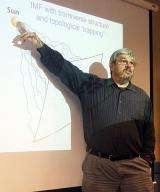
University of Delaware professor William Matthaeus says that NASA's Solar Probe Plus mission will not only advance scientific understanding of the solar wind and the heliosphere, but also likely will result in other practical and commercial applications. "NASA developed many aspects of aerospace technology that later became very useful -- in airplane design, communications satellites, GPS systems, microwave technology, computers and computer networking. Solar Probe incorporates some advanced heat shield design that will probably become more widely used eventually," he says. Credit: University of Delaware

A University of Delaware researcher is helping to design instruments for a robotic space probe that will go where no other has gone before: the sun.

William Matthaeus, professor of physics and astronomy at UD, is involved in NASA's project, which is slated to launch by 2018.

The unmanned spacecraft, the size of a small car, will plunge directly into the sun's atmosphere to help uncover answers to perplexing mysteries about the fiery ball of plasma at the center of our solar system.

"The experiments selected for Solar Probe Plus are specifically designed to solve two key questions of -- why is the sun's so much hotter than the sun's visible surface, and what propels the solar wind that affects Earth and our solar system? We've been struggling with these questions for decades and this mission should finally provide those answers," said Dick Fisher, director of NASA's Heliophysics Division, in a NASA news release.

Astrophysicists have been discussing the idea of sending an unmanned mission to the sun for years, Matthaeus says, but the technology to protect a space probe from the star's mega-heat was unavailable until recently.

To avoid the fate of the mythical Icarus, who flew too close to the sun and melted his wax-and-feather wings, the spacecraft's must be able to withstand extremely high temperatures and blasts of intense radiation in the solar atmosphere as it makes the nearly 90-million-mile trip from Earth to within 4 million miles of the sun.

"At the Solar Probe's closest approach, the light from the sun will be more than 500 times as intense as at Earth, and the surrounding gas, although very tenuous, will likely be at hundreds of thousands of degrees," Matthaeus notes. "Fortunately, NASA engineers have developed an effective special carbon-fiber heat shield and thermal control system."

The Solar Probe Plus mission encompasses five investigations totaling approximately $180 million for preliminary analysis, design, development and testing of the spacecraft and the instruments that will fly aboard it.

Matthaeus is the lead theorist on the Integrated Science Investigation of the Sun (ISIS) project, which is led by David McComas at the Southwest Research Institute in San Antonio, Texas. The team is developing two instruments for monitoring the electrons, protons and ions that are accelerated to high energies in the sun's atmosphere. This continuous stream of outward-flowing particles from the sun is known as solar wind. It causes the northern and southern lights on Earth, and can cause magnetic storms capable of knocking out electrical power grids.

"The more we rely on satellite technology, such as GPS, the more vulnerable to magnetic storms we become. So we need to understand how they work in order to protect societal assets such as satellites in space, as well as humans who explore or work in space," says Matthaeus.

"The Solar Probe Plus orbit will spiral inward. The spacecraft will eventually get as close to 9-10 solar radii, which is about 20 times closer to the than Earth is," he notes.

As the instruments aboard the spacecraft measure magnetic and electric properties, astrophysicists will be able to eliminate some theories for how is generated and better understand the heliosphere, the vast magnetic bubble that contains our solar system.

"It is a real mission of discovery, visiting the sun's immediate environment for the first time," notes Matthaeus. "All along its journey into the , Solar Probe will measure many of the ongoing processes that are responsible for maintaining and controlling the heliosphere."

Explore further: NASA head views progress on asteroid lasso mission

add to favorites email to friend print save as pdf

Related Stories

CfA will play major role in mission to 'touch' the sun

Sep 14, 2010

When NASA's Solar Probe Plus (SPP) launches before the end of the decade, it will carry a suite of cutting-edge scientific instruments. Only one - the Solar Wind Electrons Alphas and Protons (SWEAP) Investi ...

Russian sun probe lost: official

Apr 19, 2010

Russian scientists acknowledged Monday that solar research satellite Koronas-Foton has been lost due to technical problems, barely a year after its launch.

Ulysses, Fifteen Years And Going Strong

Oct 08, 2005

Fifteen years after its launch, the grand ESA/NASA Ulysses space mission is still going strong, orbiting the Sun and continuing to tell exciting stories about our nearest star. Carried into space on 6 October 1990 by the ...

Recommended for you

NASA head views progress on asteroid lasso mission

13 hours ago

Surrounded by engineers, NASA chief Charles Bolden inspected a prototype spacecraft engine that could power an audacious mission to lasso an asteroid and tow it closer to Earth for astronauts to explore.

Ecuador satellite collides with Russian space junk

13 hours ago

A small Ecuadoran satellite collided in orbit with the remains of a Russian rocket, but it is too soon to know how much damage it might have sustained, Quito's space agency said Thursday.

Forecast for Titan: Wild weather could be ahead

May 22, 2013

(Phys.org) —Saturn's moon Titan might be in for some wild weather as it heads into its spring and summer, if two new models are correct. Scientists think that as the seasons change in Titan's northern hemisphere, ...

SDO observes mid-level solar flare

May 22, 2013

UPDATE 16:30 p.m. EDT: The M7-class flare was also associated with a coronal mass ejection or CME, another solar phenomenon that can send billions of tons of particles into space. While this CME was not Ea ...

User comments : 1

Adjust slider to filter visible comments by rank

Display comments: newest first

Telperion
not rated yet Oct 07, 2010
It would be more interesting to be able to get the probe back to Earth in order to fulfill the title of the article - "visit" to the Sun.
Go there, visit it, then come back.
But apparently the probe will be KIA (The Solar Probe Plus orbit will spiral inward).

More news stories

A hidden population of exotic neutron stars

(Phys.org) —Magnetars – the dense remains of dead stars that erupt sporadically with bursts of high-energy radiation - are some of the most extreme objects known in the Universe. A major campaign using ...

Hubble reveals the ring nebula's true shape

(Phys.org) —The Ring Nebula's distinctive shape makes it a popular illustration for astronomy books. But new observations by NASA's Hubble Space Telescope of the glowing gas shroud around an old, dying, ...

Century-old science helps confirm global warming

(Phys.org) —Ocean measurements taken more than 135 years ago during the scientific expedition of HMS Challenger have provided further confirmation of human-produced global warming over the past century.

Hormone replacement therapy—clarity at last

The British Menopause Society and Women's Health Concern have today released updated guidelines on Hormone Replacement Therapy (HRT) to provide clarity around the role of HRT, the benefits and the risks. The new guidelines ...

Controlling mood through the motions of mitochondria

(Medical Xpress)—Regulating the distribution of power in neurons is done by a system that makes the national electric grid look simple by comparison. Each neuron has several thousand mitochondria confined ...

A quantum simulator for magnetic materials

Physicists understand perfectly well why a fridge magnet sticks to certain metallic surfaces. But there are more exotic forms of magnetism whose properties remain unclear, despite decades of intense research. ...