Laser spectroscopy exposes organization of water molecules under model membrane surfaces
Sep 27, 2010
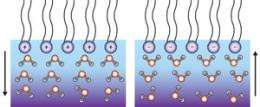
Figure 1: Schematic diagram showing that, when the air-water interface is positively charged (top left), the water molecules (bottom) will orientate ‘hydrogen-down’ (left), and when it is negatively charged they are ‘hydrogen-up’ (right). Copyright : Reproduced from Ref. 1 © 2010 Jahur A. Mondal et al.

The behavior of water molecules as they contact biological substances has long puzzled scientists. The first few layers of interfacial water can display complex arrangements that distinctly influence biochemical reactivity and function. Mapping these interfaces, however, is extremely difficult because chemical signatures of surface-bound water are often swamped by bulk liquid signals. Now, researchers led by Tahei Tahara from the RIKEN Advanced Science Institute in Wako, Japan, have developed a laser spectroscopy technique that conclusively determines the orientation of water molecules beneath charged lipid layers -- the primary components of cell membranes.

Phospholipids are fatty acid molecules that contain two parts: hydrophobic ‘tails’ made of long hydrocarbon chains and hydrophilic ‘heads’ comprised of charged phosphate groups and other organic units. At the air-water interface, phospholipids spontaneously form into monolayer films, with their tails extending into the air and their heads immersed in water. The structure and orientation of below such monolayers has been a matter of controversy. Some investigators suggest that the partially positive-charged of water orientate ‘up’ or ‘down’ to align with the lipid head charge, while others suggest the opposite outcome.

Tahara and colleagues resolved this debate by using an called heterodyne-detected vibrational sum frequency generation (HD-VSFG) spectroscopy, which has extremely high surface sensitivity. HD-VSFG combines two laser beams with different frequencies at an interface to generate a sum-frequency signal; when vibrations of surface molecules resonate with the applied laser, the sum-frequency signal rapidly shoots up—instantly identifying which chemicals are present. Because this signal originates from non-linear surface polarization effects, it contains only contributions from interfacial species. “HD-VSFG automatically probes the depths of water layers that are different from the bulk,” says Tahara.

Determining the orientation of surface water required heterodyne detection, a method that determines the phase of weak signals via interference with a reference beam. According to Tahara, performing such measurements required precisely sensing changes to the signal light’s optical phase—meaning the researchers had to control the laser beams with nanometer-scale accuracy.

The teams’ experiments on three different lipid monolayers revealed that the interfacial structures are governed by the net charge of the heads: hydrogen atoms pointed up with anionic lipid heads, and faced downwards in the presence of cationic lipids. “This is totally different from the situation for reactions in aqueous solutions,” says Tahara, who believes that the results will shed light on important reactions that take place at cell membranes, such as enzyme activation.

Explore further: Reading the unreadable

More information: Mondal, J.A., et al, Structure and orientation of water at charge lipid monolayer/water interfaces probed by heterodyne-detected vibrational sum frequency generation spectroscopy. Journal of the American Chemical Society 132, 10656-10657 (2010). pubs.acs.org/doi/abs/10.1021/ja104327t

add to favorites email to friend print save as pdf

Related Stories

A better way of lubricating human joints and implants

Nov 08, 2006

Researchers at the University of Oxford have discovered that certain lubricants reduce friction much more effectively in water or water-based solutions than in machine oil or air, which may be how the process works in biological ...

Water: the Solvent of Choice

May 16, 2005

Miscibility not required: chemical reactions "on water" faster than in organic solvents We all know what it means to put something "on ice", but what is a chemical reaction "on water"? This new expression has been coined by a ...

Identifying the 'Signatures' of Protons in Water

Jul 13, 2005

Free protons from acids associate with 1, 2 or 3 molecules of water and the structures can be identified by unique infrared laser spectrum signatures, according to a report in Science by Yale professor of chemistry Mark A ...

Emulsion with a round-trip ticket

Jun 14, 2007

Oil and water are not miscible. However, it is possible to combine both into an emulsion in which they act as a unit—for example, in creams, body lotion, milk, or mayonnaise. In these substances, one of the two liquids ...

Recommended for you

New method for producing clean hydrogen

16 hours ago

Duke University engineers have developed a novel method for producing clean hydrogen, which could prove essential to weaning society off of fossil fuels and their environmental implications.

Making ice-cream more nutritious with meat left-overs

23 hours ago

Food industries are now turning meat left-over into high-protein content ingredients for food supplements, or to be added to processed food. But a EU-wide regulation covering them is still lacking.

Non-wetting fabric drains sweat

May 20, 2013

(Phys.org) —Waterproof fabrics that whisk away sweat could be the latest application of microfluidic technology developed by bioengineers at the University of California, Davis.

Protein study suggests drug side effects are inevitable

May 20, 2013

A new study of both computer-created and natural proteins suggests that the number of unique pockets – sites where small molecule pharmaceutical compounds can bind to proteins – is surprisingly small, meaning drug side ...

User comments : 0

More news stories

New method for producing clean hydrogen

Duke University engineers have developed a novel method for producing clean hydrogen, which could prove essential to weaning society off of fossil fuels and their environmental implications.

Protein study suggests drug side effects are inevitable

A new study of both computer-created and natural proteins suggests that the number of unique pockets – sites where small molecule pharmaceutical compounds can bind to proteins – is surprisingly small, meaning drug side ...

Beautiful 'flowers' self-assemble in a beaker

By simply manipulating chemical gradients in a beaker of fluid, materials scientists at Harvard have found that they can control the growth behavior of crystals to create precisely tailored structures—such ...

Attacking MRSA with metals from antibacterial clays

In the race to protect society from infectious microbes, the bugs are outrunning us. The need for new therapeutic agents is acute, given the emergence of novel pathogens as well as old foes bearing heightened antibiotic resistance.

First Look: New Xbox elegant, but much unknown

Will gamers want One? After four years of development, Microsoft unveiled the Xbox One entertainment console and touted it as an all-in-one solution for playing games, watching TV and doing everything in ...

Sony mulls hedge fund's entertainment sale idea

Sony's CEO Kazuo Hirai says the electronics giant's board will discuss a proposal by U.S. hedge fund manager Daniel Loeb to spin off up to 20 percent of its movie, TV and music division.

Apple case seen as possible spur to tax action

Now that tech favorite Apple Inc. has been dragged front and center into the debate over the U.S. tax code, lawmakers are hoping that the spotlight on such a high-profile company could be the catalyst for ...