Canadian space agency beams northern lights over Web
Sep 20, 2010
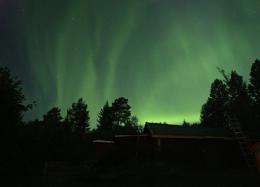
A display of the northern lights in Sweden in 2003. Skywatchers can turn their gaze to a computer for a glimpse of the northern lights: the Canadian Space Agency on Monday launched an online observatory streaming the aurora borealis live over the Internet.

Skywatchers can turn their gaze to a computer for a glimpse of the northern lights: the Canadian Space Agency on Monday launched an online observatory streaming the aurora borealis live over the Internet.

"Armchair skywatchers everywhere can now discover the wonder of the northern lights live on their home computer screen," Canadian Space Agency president Steve MacLean said in a statement.

"We hope that watching the dance of the will make you curious about the science of the sky and the relationship we have with our own star, the sun."

Auroras occur when charged particles from the Sun collide with gases in Earth's , resulting in a ribbon of lights dancing across the night sky.

The launch of the website (www.asc-csa.gc.ca/auroramax) coincides with the beginning of aurora season in northern Canada, which generally begins in late August or early September and ends in May.

Aurora enthusiasts will be able to catch the most frequent and intense auroras when the Sun reaches the most active period of its 11-year cycle, called solar maximum, in 2013.

In addition to nightly broadcasts of the , the website will also explain the science behind the phenomenon and offer tips for seeing and photographing auroras.

As well, it offers an image gallery with photographs and videos of the auroras from previous nights.

Explore further: Proba-V opens its eyes

add to favorites email to friend print save as pdf

Related Stories

Northern Lights in the classroom

Sep 01, 2010

A new model created by Lancaster University space scientist Dr Jim Wild is bringing the experience of the Northern Lights into the classroom.

Colliding auroras produce an explosion of light

Dec 17, 2009

(PhysOrg.com) -- A network of cameras deployed around the Arctic in support of NASA's THEMIS mission has made a startling discovery about the Northern Lights. Sometimes, vast curtains of aurora borealis collide, ...

Northern lights research enters final frontier

Jan 12, 2007

An international team of scientists -- including physicists from the University of Calgary -- will begin gathering the most detailed information yet about the ever-changing northern lights, as a multi-year research project ...

Recommended for you

Proba-V opens its eyes

1 hour ago

(Phys.org) —Earth watcher Proba-V is in good health following its launch last week. The Vegetation imager has been switched on and the first image has been captured over western France.

Mice, gerbils perish in Russia space flight

May 19, 2013

A number of mice and eight gerbils sent into space in a Russian capsule destined to find out how well organisms can withstand extended flights perished during their journey, scientists said Sunday as the ...

Mars rover Opportunity examines clay clues in rock

May 18, 2013

(Phys.org) —NASA's senior Mars rover, Opportunity, is driving to a new study area after a dramatic finish to 20 months on "Cape York" with examination of a rock intensely altered by water.

NASA's STEREO detects a CME from the sun

May 17, 2013

On 5:24 a.m. EDT on May 17, 2013, the sun erupted with an Earth-directed coronal mass ejection or CME, a solar phenomenon that can send billions of tons of solar particles into space that can reach Earth ...

User comments : 0

More news stories

Proba-V opens its eyes

(Phys.org) —Earth watcher Proba-V is in good health following its launch last week. The Vegetation imager has been switched on and the first image has been captured over western France.

Anabolic steroids may affect future mental health

There is a link between use of anabolic-androgenic steroids and reduced mental health later in life. This is the main conclusion of a new study on elite male strength athletes that researchers from the University of Gothenburg ...

Relaxed tourists share more

Tourists set on relaxing and socialising when they reach their holiday destination tend to do little advance research on the internet before making their trip, but are more likely to share travel information and photos on ...