'Blue Suede' premiers: New blueberry recommended for home gardeners
Sep 20, 2010
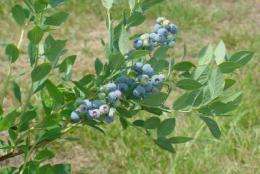
The colorful, light-blue berries of the new cultivar are abundant and flavorful. Credit: Photo by D. Scott NeSmith

Blueberry aficionados will soon have a tasty, colorful new variety for their backyard gardens. Blueberry experts D. Scott NeSmith and Mark K. Ehlenfeldt introduced 'Blue Suede' in a recent issue of HortScience. The new southern highbush blueberry (Vaccinium hybrid) was released by the University of Georgia's College of Agricultural and Environmental Sciences, the University of Georgia Agricultural Experiment Station, and the U.S. Department of Agriculture-Agricultural Research Service. 'Blue Suede' is targeted for sales to the home gardener market.

According to NeSmith and Ehlenfeldt, 'Blue Suede' produces an abundance of attractive, light-blue fruit, with large, flavorful berries. The plant of 'Blue Suede' is vigorous and features attractive deep-red fall foliage. The researchers anticipate that the plant should perform well in USDA hardiness zones 6a through 9a.

"When compared with the popular southern highbush variety 'O'Neal', 'Blue Suede' had larger berry size, more pronounced light-blue color, increased plant vigor, and considerably later flowering time," noted NeSmith. 'O'Neal' typically blooms too early for most homeowners, subjecting it to spring freeze damage during flowering; 'Blue Suede' flowers 10 to 14 days later than 'O'Neal'. 'Blue Suede™' also tends to have a protracted ripening period, a desirable trait that allows home gardeners to harvest berries over a longer period of time. The longer ripening period is less advantageous for most commercial operations, the researchers noted.

The cultivar has been exclusively licensed to McCorkle Nursery, which plans to sell the new release under the trade name 'Blue Suede'. Consumers should see the new cultivar introduced as part of McCorkle's Gardener's Confidence™ Collection in late 2010 or early 2011. Propagation rights for 'Blue Suede' are controlled by University of Georgia Research Foundation, Technology Commercialization Office in Athens, Georgia.

Explore further: Thailand urged to explore edible insect market

More information: The complete study and abstract are available on the ASHS HortScience electronic journal web site: hortsci.ashspublications.org/cgi/content/full/45/2/302

Provided by American Society for Horticultural Science

not rated yet
add to favorites email to friend print save as pdf

Related Stories

Southern farmers realize profits from highbush blueberries

Jun 30, 2008

Southern highbush blueberries are emerging as an important fruit crop in Georgia, but experienced farmers say the fruit can be a challenge to grow. To determine if the blueberry shows true promise as a profitable ...

Rare butterfly recovers in California

Aug 02, 2007

The rare El Segundo blue butterfly, once thought to be nearly extinct, is making a comeback in southern California and hanging out at the beach.

Rare New Year's Eve 'blue moon' to ring in 2010

Dec 29, 2009

(AP) -- Once in a blue moon there is one on New Year's Eve. Revelers ringing in 2010 will be treated to a so-called blue moon. According to popular definition, a blue moon is the second full moon in a month. ...

Recommended for you

Drought makes Borneo's trees flower at the same time

27 minutes ago

Tropical plants flower at supra-annual irregular intervals. In addition, mass flowering is typical for the tropical forests in Borneo and elsewhere, where hundreds of different plant timber species from the ...

Fast new, one-step genetic engineering technology

33 minutes ago

A new, streamlined approach to genetic engineering drastically reduces the time and effort needed to insert new genes into bacteria, the workhorses of biotechnology, scientists are reporting. Published in ...

100K Pathogen Genome Project maps first genomes

1 hour ago

(Phys.org) —Striking a blow at foodborne diseases, the 100K Pathogen Genome Project at the University of California, Davis, today announced that it has sequenced the genomes of its first 10 infectious microorganisms, including ...

Getting to the bottom of the zombie ant phenomenon

1 hour ago

(Phys.org) —While unraveling a dramatic case of mind control, biologist David Hughes is taking calls from Hollywood—and gaining new insights into the role behavior plays in spreading disease.

New DNA cattle test beefs up dairy and meat quality

1 hour ago

(Phys.org) —A genomics technique developed at Cornell to improve corn can now be used to improve the quality of milk and meat, according to research published online May 17 in the journal PLOS ONE.

User comments : 0

More news stories

Fast new, one-step genetic engineering technology

A new, streamlined approach to genetic engineering drastically reduces the time and effort needed to insert new genes into bacteria, the workhorses of biotechnology, scientists are reporting. Published in ...

Drought makes Borneo's trees flower at the same time

Tropical plants flower at supra-annual irregular intervals. In addition, mass flowering is typical for the tropical forests in Borneo and elsewhere, where hundreds of different plant timber species from the ...

100K Pathogen Genome Project maps first genomes

(Phys.org) —Striking a blow at foodborne diseases, the 100K Pathogen Genome Project at the University of California, Davis, today announced that it has sequenced the genomes of its first 10 infectious microorganisms, including ...

Strawberry fields forever and fungus-free

(Phys.org) —Strawberries are one of the most economically important berry crops in the world, and a high value export crop for the Australian horticultural industry.For the first time, researchers at The ...

Theorists weigh in on where to hunt dark matter

(Phys.org) —Now that it looks like the hunt for the Higgs boson is over, particles of dark matter are at the top of the physics "Most Wanted" list. Dozens of experiments have been searching for them, but ...

DNA damage: The dark side of respiration

(Phys.org) —Adventitious changes in cellular DNA can endanger the whole organism, as they may lead to life-threatening illnesses like cancer. Researchers at LMU now report how byproducts of respiration cause mispairing ...