500 million year old fossils discovered on new site
September 17, 2010 By Anneli Waara
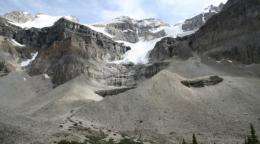
Working area at Stanley Glacier, Kootenay National Park. Foto/bild: © ROM (foto/bild JB Caron)
During an expedition into the Canadian Rocky Mountains in 2008, a Canadian-led team including Swedish researchers from Uppsala University found a new site with exceptionally preserved fossils. The site and its fossils have now been made public in this month's issue of Geology.
The discovered fossils, including a new form of giant predator, are equivalent in age to the world-famous Burgess Shale. However, the sediments of the new site have been deposited in an entirely different environment than the Burgess Shale, where nobody would have expected such exceptional preservation.
Following reports by hikers of unusual fossils in the Stanley Glacier area of Kootenay National Park (British Columbia, Canada), a 2-week expedition was initiated by the Royal Ontario Museum (Toronto, Canada) in 2008 to investigate the area. On board the team of five scientists led by Jean-Bernard Caron (ROM) were Uppsala researchers Allison Daley and Michael Streng. The discoveries made, after just a few days, were far beyond the expectations of any team member.
Hundreds of fossils were found at Stanley Glacier, including eight completely new animals and dozens of beautifully preserved specimens of arthropods, brachiopods, trilobites, molluscs, and sponges. A photograph of a particularly well-preserved sponge called Diagoniella was chosen to adorn the front cover of September’s issue of Geology. One of the new animals, Stanleycaris, belongs to a group of monster predators called the anomalocaridids. These creatures were up to one meter in length and had a segmented crayfish-like body with spiny head appendages and a circular mouth with sharp teeth; they were undoubtedly the most formidable predators of the Cambrian seas. Also found at Stanley Glacier is a wide multi-segmented arthropod similar to an animal from the Chengjiang biota of China but found for the first time in North America, and the first example of the elusive appendages of Tuzoia, a Cambrian arthropod previously only known from its spiky body shield and large eyes.
Although the new site is part of the same rock unit the Burgess Shale belongs to, the discovery of such spectacular fossils at Stanley Glacier was a complete surprise. The ancient ocean, in which the rock unit was deposited ca. 505 Ma ago, was characterized by a submarine cliff called an escarpment that divided the area in a deep basin and a shallow shelf. This escarpment was thought to play a decisive role in the remarkable preservation of the Burgess Shale biota, as all previous localities yielding Burgess Shale fossils were found in the deep basin crowded close against the base of the escarpment. The site at Stanley Glacier, however, was deposited in the shallower shelf area above the escarpment. This throws the importance of the escarpment for exceptional preservation into question and opens up many opportunities to find more new fossil sites.
The Burgess Shale (part of the UNESCO World Heritage Canadian Rocky Mountain Parks) and its exceptionally preserved fossils present a remarkable snapshot of Cambrian marine life. It celebrated its 100th anniversary of discovery last year, and new important research discoveries continue to emerge from this site, and new sites such as Stanley Glacier. Other recent discoveries include a primitive squid-like organism Nectocaris (Smith and Caron, 2010, Nature), and another new anomalocaridid Hurdia (Daley et al. 2009, Science), showing that this famous fossil site has more secrets to reveal as it enters its second century of research.
More information: A new Burgess Shale-type assemblage from the “thin” Stephen Formation of the southern Canadian Rockies by Jean-Bernard Caron, et al, appears in the September 2010 issue of Geology.
Provided by
Uppsala University
-
From lemons to lemonade: Reaction uses carbon dioxide to make carbon-based semiconductor,
33 comments
-
Thioridazine kills cancer stem cells in human while avoiding toxic side-effects of conventional cancer treatments,
3 comments
-
SpaceX private rocket blasts off for space station (Update),
42 comments
-
Landmark calculation clears the way to answering how matter is formed,
55 comments
-
Research team claims to have found evidence Lake Cheko is impact crater for Tunguska Event,
18 comments
-
osmotic pressure vs diffusion
4 hours ago
-
What would stain as translucent on light-coloured fabric?
May 26, 2012
-
How do I identify different bacteria on culture plates?
May 26, 2012
-
Why Do Dogs do Strange things...
May 25, 2012
-
What does exophillic and endophillic mean in terms of mosquito and their control?
May 24, 2012
-
Semen stains glows under black lights (uv light)?
May 23, 2012
- More from Physics Forums - Biology
More news stories
Change in developmental timing was crucial in the evolutionary shift from dinosaurs to birds: study
At first glance, it's hard to see how a common house sparrow and a Tyrannosaurus Rex might have anything in common. After all, one is a bird that weighs less than an ounce, and the other is a dinosaur that ...
Other Sciences / Archaeology & Fossils
12 hours ago |
5 / 5 (8) |
0
|
Social welfare cuts ultimately come with heavy price, researchers say
(Phys.org) -- Slashing government funding for Medicaid, food stamps and other programs that serve the poor while politically popular with some lawmakers and many conservatives may do more harm ...
Other Sciences / Social Sciences
May 24, 2012 |
4.1 / 5 (23) |
156
Ancient Bethlehem seal unearthed in Jerusalem
Israeli archaeologists have discovered a 2,700-year-old seal that bears the inscription "Bethlehem," the Israel Antiquities Authority announced Wednesday, in what experts believe to be the oldest artifact ...
Other Sciences / Archaeology & Fossils
May 23, 2012 |
3.3 / 5 (15) |
24
Dollars and sense: Why are some people morally against tax?
As the U.S. presidential election campaigns heat up, the economic debate is dominated by bailouts, austerity and, inevitably, taxation. Now a new study published in Symbolic Interaction asks why tax is such an important issue ...
Other Sciences / Social Sciences
May 23, 2012 |
2.3 / 5 (3) |
20
Oldest Jewish archaeological evidence on the Iberian Peninsula
German archaeologists of the Friedrich Schiller University Jena found one of the oldest archaeological evidence so far of Jewish Culture on the Iberian Peninsula at an excavation site in the south of Portugal, ...
Other Sciences / Archaeology & Fossils
May 25, 2012 |
4.2 / 5 (6) |
12
Stunning image of smallest possible five-ringed structure
Scientists have created and imaged the smallest possible five-ringed structure about 100,000 times thinner than a human hair and you'll probably recognise its shape.
'Unzipped' carbon nanotubes could help energize fuel cells, batteries
Multi-walled carbon nanotubes riddled with defects and impurities on the outside could replace some of the expensive platinum catalysts used in fuel cells and metal-air batteries, according to scientists at ...
Computer model used to pinpoint prime materials for efficient carbon capture
When power plants begin capturing their carbon emissions to reduce greenhouse gases and to most in the electric power industry, it's a question of when, not if it will be an expensive undertaking.
T cells 'hunt' parasites like animal predators seek prey, study shows
By pairing an intimate knowledge of immune-system function with a deep understanding of statistical physics, a cross-disciplinary team at the University of Pennsylvania has arrived at a surprising finding: T cells use a movement ...
Yale study concludes public apathy over climate change unrelated to science literacy
Are members of the public divided about climate change because they don't understand the science behind it? If Americans knew more basic science and were more proficient in technical reasoning, would public consensus match ...
Land and sea species differ in climate change response: study
(Phys.org) -- Marine and terrestrial species will likely differ in their responses to climate warming, new research by Simon Fraser University and Australia’s University of Tasmania has found.