Scientists decode genomes of sexually precocious fruit flies
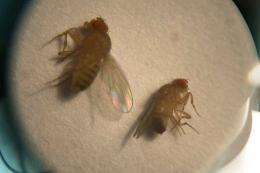
(PhysOrg.com) -- UC Irvine researchers have deciphered how lowly fruit flies bred to rapidly develop and reproduce actually evolve over time. The findings, reported in the Sept. 15 online issue of Nature, contradict the long-held belief that sexual beings evolve the same way simpler organisms do and could fundamentally alter the direction of genetic research for new pharmaceuticals and other products.
"This is actually decoding the key DNA in the evolution of aging, development and fertility," said ecology & evolutionary biology professor Michael Rose, whose laboratory began breeding the "super flies" used in the current study in 1991 - or 600 generations ago. He joked that they "live fast and die young."
Lead author and doctoral student Molly Burke compared the super flies to a control group on a genome-wide basis, the first time such a study of a sexually reproducing species has been done. The work married DNA "soup" gathered from the adapted flies with cheap, efficient technology that uses cutting-edge informatics tools to analyze the DNA of entire organisms. Burke found evidence of evolution in more than 500 genes that could be linked to a variety of traits, including size, sexual maturation and life span, indicating a gradual, widespread network of selective adaptation.
"It's really exciting," she said. "This is a new way of identifying genes that are important for traits we're interested in - as opposed to the old hunting and pecking, looking at one gene at a time."
For decades, most researchers have assumed that sexual species evolve the same way single-cell bacteria do: A genetic mutation sweeps through a population and quickly becomes "fixated" on a particular portion of DNA. But the UCI work shows that when sex is involved, it's far more complicated.
"This research really upends the dominant paradigm about how species evolve," said ecology & evolutionary biology professor Anthony Long, the primary investigator.
Based on that flawed paradigm, Rose noted, drugs have been developed to treat diabetes, heart disease and other maladies, some with serious side effects. He said those side effects probably occur because researchers were targeting single genes, rather than the hundreds of possible gene groups like those Burke found in the flies.
Most people don't think of flies as close relatives, but the UCI team said previous research had established that humans and other mammals share 70 percent of the same genes as the tiny, banana-eating insect known as Drosophila melanogaster.
Scientists who did not participate in the work agreed that it could change the direction of much research. "Anyone who expects to find a single solution for problems like aging will be disappointed, because this work suggests there's no one genetic target that could be fixed," said Richard Lenski, an evolutionary biologist at Michigan State University. "On the other hand, it means there are many genetic factors that can be further investigated."
Provided by University of California -- Irvine


