Arctic storms to decrease with global warming: study
Sep 15, 2010
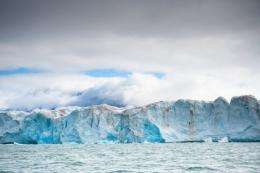
The Kongsbreen glacier taken in the Norvegian fjord Kongsfjord off the coast of Ny-Alesund in June 2010. Brief but vicious Arctic storms known as polar lows are likely to become much less frequent as global warming intensifies, scientists in Britain determined on Wednesday.

Brief but vicious Arctic storms known as polar lows are likely to become much less frequent as global warming intensifies, scientists in Britain determined on Wednesday.

Polar lows brew in ice-free high latitudes in the North Atlantic in winter and can swiftly become a hazard for shipping and oil rigs.

The number of these storms averaged 36 per season in the 20th century, climatologists at the University of Reading said.

By 2100, this tally would fall to between 17 and 23 per season, depending on concentrations of heat-trapping in the air.

"There would be roughly only half as many in future," Matthias Zahn, of the university's Environmental Systems Science Centre, told AFP.

The simulation is based on three scenarios for greenhouse-gas emissions used by the UN's Intergovernmental Panel on Climate Change (IPCC).

The reason for the fall lies in a change in the difference in temperature between the ocean's surface and the mid-atmosphere.

This differential is what causes a polar low to develop. Changing the difference hampers the storm's formation and intensification, according to the paper, released by Nature, the British science journal.

Zahn said further work was underway to simulate polar lows in the northern Pacific.

Explore further: Professor argues Earth's mantle affects long-term sea-level rise estimates

add to favorites email to friend print save as pdf

Related Stories

On the trail of polar lows

Dec 12, 2008

This has made it possible to determine, for the first time, the frequency of such polar lows in the past.

Scientists want polar bear protection

Jun 20, 2006

A U.S. climate researcher is leading a team of 30 North American and European scientists in urging the polar bear be listed as a threatened species.

Dirty snow may warm Arctic as much as greenhouse gases

Jun 06, 2007

The global warming debate has focused on carbon dioxide emissions, but scientists at UC Irvine have determined that a lesser-known mechanism -- dirty snow -- can explain one-third or more of the Arctic warming ...

Recommended for you

Strong earthquake at exceptional depth

12 hours ago

This morning at 05:45 CEST, the earth trembled beneath the Okhotsk Sea in the Pacific Northwest. The quake, with a magnitude of 8.2, took place at an exceptional depth of 605 kilometers. Because of the great ...

Marine forecasting on the horizon for Indian Ocean Rim

12 hours ago

Nearly all of the member countries of the Indian Ocean Rim Association for Regional Cooperation (IOR-ARC) will attend the week-long workshop to further cooperation and understanding on international ocean ...

Russia evacuates drifting Arctic research station

May 23, 2013

Russia has ordered the urgent evacuation of the 16-strong crew of a drifting Arctic research station after ice floe that hosts the floating laboratory began to disintegrate, officials said Thursday.

User comments : 0

More news stories

Galaxies fed by funnels of fuel

(Phys.org) —Computer simulations of galaxies growing over billions of years have revealed a likely scenario for how they feed: a cosmic version of swirly straws.

Dark, massive asteroid to fly by Earth on May 31

It's 1.7 miles long. Its surface is covered in a sticky black substance similar to the gunk at the bottom of a barbecue. If it impacted Earth it would probably result in global extinction. Good thing it is ...

Source of life running out: water scientists

The majority of people on Earth people will face severe water shortages within a generation or two if pollution and waste continues unabated, scientists warned at a conference in Bonn Friday.

Google eyes emerging markets networks

Google has become deeply involved in a series of projects to build and operate wireless networks in emerging markets including sub-Saharan Africa and Southeast Asia, a report said Friday.