Melting sea ice forces walruses ashore in Alaska
Sep 13, 2010 By SETH BORENSTEIN , AP Science Writer
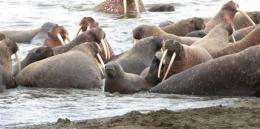
This Sept. 7, 2010 picture provided by the U.S. Geological Survey shows a walrus calf looking out from the group at the beach line near Point Lay, Alaska. Tens of thousands of walruses have come ashore in northwest Alaska because the sea ice they normally rest on has melted. Federal scientists say this massive move to shore by walruses is unusual in the United States. (AP Photo/U.S. Geological Survey)

(AP) -- Tens of thousands of walruses have come ashore in northwest Alaska because the sea ice they normally rest on has melted.

Federal scientists say this massive move to shore by is unusual in the United States. But it has happened at least twice before, in 2007 and 2009. In those years also was at or near record low levels.

The walruses "stretch out for one mile or more. This is just packed shoulder-to-shoulder," U.S. Geological Survey biologist Anthony Fischbach said in a telephone interview from Alaska. He estimated their number at tens of thousands.

Scientists with two federal agencies are most concerned about the one-ton female walruses stampeding and crushing each other and their smaller calves near Point Lay, Alaska, on the . The U.S. Fish and Wildlife Service is trying to change airplane flight patterns to avoid spooking the animals. Officials have also asked locals to be judicious about hunting, said agency spokesman Bruce Woods.

The federal government is in a year-long process to determine if walruses should be put on the .

Fischbach said scientists don't know how long the walrus camp-out will last, but there should be enough food for all of them.

During normal summers, the males go off to play in the Bering Sea, while the females raise their young in the Chukchi. The females rest on sea ice and dive from it to the sea floor for clams and worms.

"When they no longer have a place to rest, they need to go some place and it's a long commute," Fischbach said. "This is directly related to the lack of sea ice."

Loss of sea ice in the Chukchi this summer has surprised scientists because last winter lots of old established sea ice floated into the region, said Mark Serreze, director of the National Snow and Ice Data Center in Boulder, Colo. But that has disappeared.

Although last year was a slight improvement over previous years, Serreze says there's been a long-term decline that he blames on global warming.

"We'll likely see more summers like this," he said. "There is no sign of Arctic recovery."

Explore further: Bay Area thrushes nest together, winter together, and face change together

More information: U.S. Geological Survey walrus research site: http://alaska.usgs.gov/science/biology/walrus/index.html
The National Snow and Ice Data Center: http://nsidc.org/arcticseaicenews/index.html

4.2 /5 (5 votes)
add to favorites email to friend print save as pdf

Related Stories

Warming Arctic strands walrus calves

Apr 16, 2006

Lone walrus calves facing starvation after separation from their mothers appear to be more common in the Arctic, scientists say.

Recommended for you

Hong Kong dolphin numbers dwindling quickly

14 hours ago

Conservationists Tuesday warned that the number of rare Chinese white dolphins in Hong Kong waters has fallen to its lowest level in a decade of monitoring, and urged the government to immediately create more protected areas.

WWF urges Romania, Bulgaria to protect wild sturgeon

16 hours ago

Conservationist group WWF on Tuesday urged Romania and Bulgaria, home to the last viable wild sturgeon populations in the European Union, to protect the species, threatened by illegal fishing and caviar trade.

New resource to record Britain's trees launched

19 hours ago

Treezilla, the monster map of trees, was launched by The Open University and partners on 14 June 2013. The citizen science project aims to map every tree in Britain through Treezilla.org and the related apps.

Study reveals disease-causing parasites in dead otters

20 hours ago

Research undertaken by the Cardiff University Otter Project has revealed a number of disease-causing parasites in the bodies of dead otters. The findings were revealed at the BBC Summer of Wildlife event ...

Millions of moths mass on Madrid

Jun 17, 2013

Millions of moths have engulfed Madrid in a population explosion blamed on spring rains, a sudden blast of summer heat and winds that have wafted them in as unwelcome guests to the Spanish capital.

User comments : 0

More news stories

Origins of 'The Hoff' crab revealed (w/ Video)

The history of a new type of crab, nicknamed 'The Hoff' because of its hairy chest, which lives around hydrothermal vents deep beneath the Southern Ocean and Indian Ocean, has been revealed for the first ...

3D printing tiny batteries

(Phys.org) —3D printing can now be used to print lithium-ion microbatteries the size of a grain of sand. The printed microbatteries could supply electricity to tiny devices in fields from medicine to communications, ...