New ways to chart our maritime past
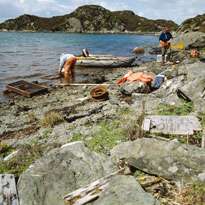
Archaeology has a long-standing tradition in protecting areas on land. But there is little attention to cultural monuments at the sea-shore and under water. To help locating these artifacts, meteorologist Marianne Nitter has introduced the concept of "climate-space." Inspired by the term "landscape room," this concept enables archaeologist to convey and incorporate abstract meteorological phenomena into the field of archaeology.
"Archaeology has a long-standing tradition in protecting areas on land. But unfortunately, there is little attention to cultural monuments at the sea-shore and under water," says meteorologist Marianne Nitter at the University of Stavanger's Museum of Archaeology.
"These may include mooring and landing sites, jetties, boat-houses, standing stones and house remains - objects which can inform us about prehistoric maritime culture and our ancestors' mobility and travelling routes," she adds.
Together with her colleague, geologist Lotte Selsing, and marine archaeologist Endre Elvestad at Stavanger Maritime Museum, Nitter has studied the protection of maritime cultural monuments.
These objects are very vulnerable, as they are exposed to rising sea levels, increasing maritime traffic and extreme weather, she explains. Tall waves and more frequent storm surges can obliterate them altogether.
"The process of recording underwater and near-shore cultural artefacts was initiated relatively late in Norway, so we simply don't know how many of them there are. And we cannot protect monuments that are neither located nor registered," Nitter says.
Introducing climate-space
To help locating these artefacts, Nitter has introduced the concept of 'climate-space'. Inspired by the term 'landscape room', this concept enables archaeologist to convey and incorporate abstract meteorological phenomena into the field of archaeology.
A climate-space is an area with homogenous temperature, precipitation, wind direction and wind force, Nitter explains. Valleys, groves, mountains, lakes, fiords and slopes are all examples of local climate-spaces.
The area is defined by topography and vegetation, which limits the occurrence of various weather phenomena. Furthermore, a climate-space is defined by calculating the weather phenomena's time scale, the climate parameter to which you relate it to - such as temperature, rainfall or wind - and the topographic lines of the landscape. These three parameters are mutually dependent.
"The climate-space may change rapidly, and in step with changing parameters. Wind direction may change within minutes, and vegetation over a few seasons," says Nitter.
Go with the wind
Iron Age vessels could be landed in very shallow waters, which are now only accessible by dingy boats. As ships got bigger and deeper draught, a number of landing sites of the Viking and early Middle Ages were abandoned during the 14th and 15th centuries.
The climate-space concept is particularly helpful in finding the oldest seafaring routes and landing places. By using this method, scientists can estimate wind and wave conditions inside a fiord. They may also assess the fetch - the distance over which the wind of a certain speed blows - and thereby determine the height of the waves. By calculating wind and waves, scientists are able to chart landing sites which are no longer in use.
"By applying fetch and climate-space calculation to a particular landing site, you will see that the location of the harbour is adapted to the prevailing wind directions and most favourable wave conditions," says Nitter.
After locating the best prehistoric landing places, we are likely to find cultural monuments, she asserts.
Different protection strategies
"Scientists have issued some alarming conservation forecast for 2050 and 2100. When sea levels rise because of global warming, the maritime environment is bound to change. How will we then be able to protect our cultural heritage?" Nitter asks.
Elvestad, Selsing and Nitter are concerned about Norway's marine cultural heritage. They urge Norway's Directorate for cultural heritage to consider the erosion of sediments, which - according to new analyses -happens faster than expected. Furthermore, it should take into account the rising sea levels, which will require protection plans to extend beyond the next century.
"The Directorate for cultural heritage should prepare vulnerability analyses of the most heavily exposed maritime cultural monuments," geologist Lotte Selsing says.
There are two ways of protecting maritime heritage, she adds. One is to excavate the artefacts, the other is to leave them in situ - where they are. Some object will be preserved naturally, as they are sealed by younger sediments. Artificial sealing is less common, but should be considered as a protection strategy for maritime heritage.
Yet another precautionary measure is to install a wave absorber, in places where rising sea levels are threatening the heritage.
Elvestad, Selsing and Nitter are continuing their work on protection plans and -strategies. They have now shifted their attention to the Bronze Age - a time when majestic burial mounds acted as navigation marks for seafarers.
Provided by University of Stavanger


