Planets Align for the Perseid Meteor Shower
Aug 06, 2010 by Dr. Tony Phillips
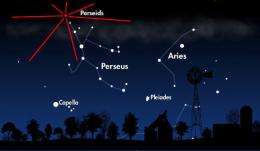
Looking northeast around midnight on August 12th-13th. The red dot is the Perseid radiant. Although Perseid meteors can appear in any part of the sky, all of their tails will point back to the radiant.

You know it's a good night when a beautiful alignment of planets is the second best thing that's going to happen. Thursday, August 12th, is such a night.

The show begins at sundown when Venus, Saturn, Mars and the crescent Moon pop out of the western twilight in tight conjunction. All four heavenly objects will fit within a circle about 10 degrees in diameter, beaming together through the dusky colors of sunset. No telescope is required to enjoy this naked-eye event: sky map:
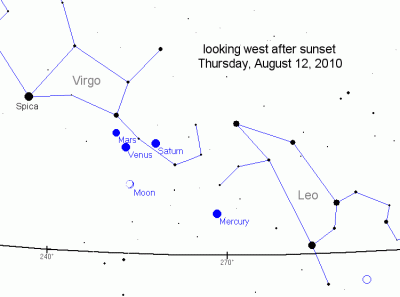
The planets will hang together in the western sky until 10 pm or so. When they leave, following the sun below the horizon, you should stay, because that is when the Perseid begins. From 10 pm until dawn, will flit across the starry sky in a display that's even more exciting than a planetary get-together.

The is caused by debris from Comet Swift-Tuttle. Every 133 years the huge comet swings through the and leaves behind a trail of dust and gravel. When Earth passes through the debris, specks of comet-stuff hit the atmosphere at 140,000 mph and disintegrate in flashes of light. These meteors are called Perseids because they fly out of the constellation Perseus.

Swift-Tuttle's debris zone is so wide, Earth spends weeks inside it. Indeed, we are in the outskirts now, and sky watchers are already reporting a trickle of late-night Perseids. The trickle could turn into a torrent between August 11th and 13th when Earth passes through the heart of the debris trail.

2010 is a good year for Perseids because the Moon won't be up during the midnight-to-dawn hours of greatest activity. Lunar glare can wipe out a good meteor shower, but that won't be the case this time.

As Perseus rises and the night deepens, meteor rates will increase. For sheer numbers, the best time to look is during the darkest hours before dawn on Friday morning, Aug. 13th, when most observers will see dozens of Perseids per hour.

For best results, get away from city lights. The darkness of the countryside multiplies the visible meteor rate 3- to 10-fold. A good dark sky will even improve the planetary alignment, allowing faint Mars and Saturn to make their full contribution to the display. Many families plan camping trips to coincide with the Perseids. The Milky Way arching over a mountain campground provides the perfect backdrop for a meteor shower.

Enjoy the show!

Explore further: Engineering students develop a super 'space stethoscope'

Related Stories

The Perseids are Coming

Jul 31, 2009

Earth is entering a stream of dusty debris from Comet Swift-Tuttle, the source of the annual Perseid meteor shower. Although the shower won't peak until August 11th and 12th, the show is already getting underway. ...

STAR TRAK: August 2010

Aug 02, 2010

Every three years, the same phase of the moon happens on about the same date of each month. The annual Perseid meteor shower of August last happened in a moonless sky in 2007, so this year if the sky is clear ...

Perseid Earthgrazers

Aug 08, 2006

Blame it on the Moon: The 2006 Perseid meteor shower is going to be a dud. Oh, Earth will pass through the Perseid meteoroid stream, as usual. And meteors will flit across the sky. But when the shower peaks ...

The Perseids are Coming

Aug 10, 2009

Splat! There goes another bug on the windshield. Anyone who's ever driven down a country lane has seen it happen. A fast moving car, a cloud of multiplying insects, and a big disgusting mess.

Perseid Meteor Shower Peaks Tuesday, Aug. 12

Aug 07, 2009

(PhysOrg.com) -- It's time once again for nature to put on its late-summer fireworks show: the Perseid meteor shower. This year's best viewing will be before dawn on Aug. 12, with a second chance after sunset ...

Recommended for you

Forecast for Titan: Wild weather could be ahead

9 hours ago

(Phys.org) —Saturn's moon Titan might be in for some wild weather as it heads into its spring and summer, if two new models are correct. Scientists think that as the seasons change in Titan's northern hemisphere, ...

SDO observes mid-level solar flare

10 hours ago

UPDATE 16:30 p.m. EDT: The M7-class flare was also associated with a coronal mass ejection or CME, another solar phenomenon that can send billions of tons of particles into space. While this CME was not Ea ...

NASA's IRIS mission readies for a new challenge

19 hours ago

(Phys.org) —The time draws near. NASA is getting ready to launch a new mission, a mission to observe a largely unexplored region of the solar atmosphere that powers its dynamic million-degree outer atmosphere and drives ...

User comments : 0

More news stories

Forecast for Titan: Wild weather could be ahead

(Phys.org) —Saturn's moon Titan might be in for some wild weather as it heads into its spring and summer, if two new models are correct. Scientists think that as the seasons change in Titan's northern hemisphere, ...

Theorists weigh in on where to hunt dark matter

(Phys.org) —Now that it looks like the hunt for the Higgs boson is over, particles of dark matter are at the top of the physics "Most Wanted" list. Dozens of experiments have been searching for them, but ...