Scientists grow 'sea urchin'-shaped structures
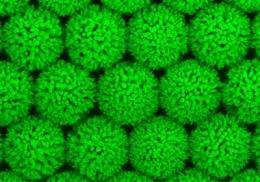
Swiss researchers have succeeded in growing sea-urchin shaped nanostructures from minute balls of polystyrene beads using a simple electrochemical process. The spines of the sea urchin consist of zinc oxide nanowires. The structured surface should help increasing the efficiency of photovoltaic devices.
Processes which lend materials new characteristics are generally complicated and therefore often rather difficult to reproduce. So surprise turns to astonishment when scientists report on new methods which not only produce outstanding results despite the fact that they use economically priced starting materials but also do not need expensive instrumentation.
Just a simple framework made of polystyrene
This is exactly what Jamil Elias and Laetitia Philippe of Empa's Mechanics of Materials and Nanostructures Laboratory in Thun have succeeded in doing. They used polystyrene spheres as a sort of scaffolding to create three-dimensional nanostructures of semiconducting zinc oxide on various substrates. The two scientists are convinced that the (nanostructured) "rough" but regularly-structured surfaces they have produced this way can be exploited in a range of electronic and optoelectronic devices such as solar cells and also short wave lasers, light emitting diodes and field emission displays.
The scientific world reacted promptly. The paper in which the results were reported was published in January 2010 in the on line edition of Advanced Materials. In the same month it became the most frequently downloaded article, and in April it was selected to appear on the Inside Front Cover of the journal.
The principle behind the process is quite simple. Little spheres of polystyrene a few micrometers in diameter are placed on an electrically conducting surface where they orient themselves in regular patterns. Polystyrene is cheap and ubiquitous - it is widely used as a packaging material (for example for plastic yoghurt pots) or as insulating material in expanded form as a solidified foam.
Hollow bodies with prickles for photovoltaic applications
The tiny balls of polystyrene anchored in this way form the template on which the nanowires are desposited. Jamil Elias has succeeded in using an electrochemical method which himself has developed to vary the conductivity and electrolytic properties of the polystyrene balls in such way that the zinc oxide is deposited on the surface of the microspheres. Over time regular nanowires grow from this surface, and when this process is complete the polystyrene is removed, leaving behind hollow spherical structures with spines - little sea-urchins, as it were! Tightly packed on the underlying substrate, the sea-urchins lend it a three-dimensional structure, thereby increasing considerably its surface area.
This nanostructured surface is predestined for use in photovoltaic applications. The researchers expect that it will have excellent light scattering properties. This means the surface will be able to absorb significantly more sunlight and therefore be able to convert radiated energy into electricity more efficiently. In a project supported by the Swiss Federal Office of Energy (SFOE), Laetitia Philippe and her research team are developing extremely thin absorbers (ETAs) for solar cells, based these zinc oxide nanostructures.
More information: J. Elias, et al.: Hollow Urchin - like ZnO thin Films by Electrochemical Deposition, Advanced Materials, Volume 22, Issue 14, Pages 1607 - 1612 (April 12, 2010) DOI:10.1002/adma.200903098
Provided by EMPA


