Weather kite gets second wind
Jul 23, 2010
Weather kite gets second wind

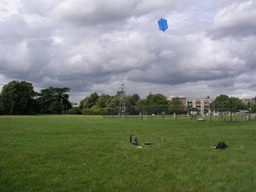
The red kite is now a commonly-seen bird of prey in the skies of the south-east, but a specially designed artificial blue kite promises a new way to make weather measurements.

Writing in the Review of Scientific Instruments, scientists at the University of Reading's Department of Meteorology describe a high-tech kite developed to measure wind speed. Kites have long been used to transport instruments up into the lower atmosphere, but rather than just offering a convenient "sky hook", the new approach uses the kite itself to detect the wind variations.

The speed varies the kite line's tension, which can be measured conveniently at the ground, rather than by carrying a sensor up on the kite aloft.

Kieran Walesby, who developed the instrumentation as part of his postgraduate research work at Reading, said: "This technique allows above the ground to be measured without the need for a fixed instrument tower, and is therefore very portable."

The kite used in these experiments was specially built in the Department of Meteorology, and was combined with a tension-measuring system optimised to overcome during long kite flights. The kite line tension is found by measuring the small distortions generated on a metal ring used to anchor the kite, using a set of miniature strain gauges.

Professor Giles Harrison, Professor of who supervised the work, said: "Benjamin Franklin's 1752 experiment is a famous early example of using a kite to measure atmospheric properties. Our system reasserts the kite's value in , through offering an easily-implemented method for investigating lower atmosphere air flows, such as those which transport pollution."

Explore further: NASA's Landsat satellite looks for a cloud-free view

Provided by University of Reading

4 /5 (1 vote)
add to favorites email to friend print save as pdf

Related Stories

Invasive snail may damage diet of rare Everglades bird

Feb 04, 2010

(PhysOrg.com) -- Invasive animals often wreak havoc with their feeding habits; however, University of Florida researchers say a huge South American snail is causing problems when it’s the prey rather than ...

Students test 'space postal service' during Foton mission

May 10, 2007

How do you deliver a parcel down to Earth from space without using a rocket engine and fuel" The answer is YES2, a student experiment that was prepared, built and tested at ESA's research and technology centre, ...

Researchers fly a kite for manure recycling

Dec 01, 2008

Researchers at North Wyke Research, and Lancaster and Exeter universities, have come up with an advice system to help farmers recycle manure safely and avoid polluting watercourses.

Recommended for you

NASA's Landsat satellite looks for a cloud-free view

9 hours ago

For decades, Landsat satellites have documented the desiccation of the Aral Sea in Central Asia. Once one of the largest seas in the world, it shrunk to a tenth of its original volume after Russia diverted ...

Volcanoes cause climate gas concentrations to vary

17 hours ago

Trace gases and aerosols are major factors influencing the climate. With the help of highly complex installations, such as MIPAS on board of the ENVISAT satellite, researchers try to better understand the ...

Explainer: Why are tornadoes so destructive?

17 hours ago

Tornadoes are a part of life for people living in the Great Plains of the United States. In Oklahoma, a state that averages 62 tornadoes a year, people are prepared as best as they can be and are well warned.

User comments : 0

More news stories

Forecast for Titan: Wild weather could be ahead

(Phys.org) —Saturn's moon Titan might be in for some wild weather as it heads into its spring and summer, if two new models are correct. Scientists think that as the seasons change in Titan's northern hemisphere, ...

Theorists weigh in on where to hunt dark matter

(Phys.org) —Now that it looks like the hunt for the Higgs boson is over, particles of dark matter are at the top of the physics "Most Wanted" list. Dozens of experiments have been searching for them, but ...